
Why Japanese Neighborhoods Look So Visually Chaotic
Walk through a neighborhood in France, or Germany, or the American Northeast, and something registers almost immediately — a tone. The houses share a material, a palette, a roofline, a logic. You can’t always name it, but it’s there. The street feels like it was planned, or at least like it grew according to some shared understanding of what a neighborhood should look like.
Now walk through a residential street in Japan.
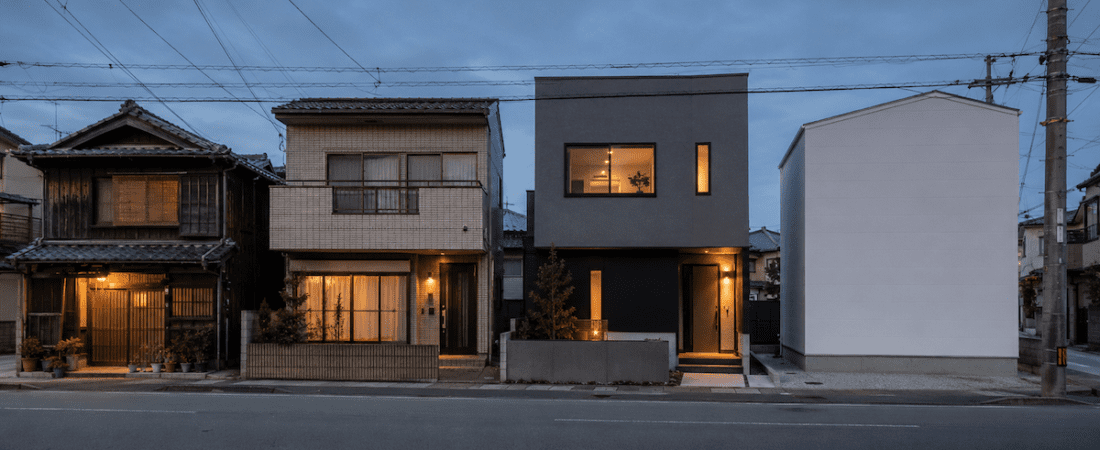
You’ll find a narrow two-story from the 1970s with ceramic tile siding in faded beige, wedged between a boxy minimalist cube from the 2010s and a house that appears to have been designed by someone who really liked the idea of a European chalet. On the corner: a brand new prefab with clean white walls and no windows facing the street. Behind it: something that might be original to the postwar era, still standing, somehow.
It’s not ugly, exactly. But it’s also clearly not coordinated.
The Law Allows It — Actually, It Encourages It
This isn’t an accident. It’s policy.
Japan’s building codes regulate health and safety with characteristic thoroughness. Structural integrity, setbacks, fire prevention — all tightly controlled. But in ordinary residential neighborhoods, aesthetic appearance is lightly regulated compared with many European cities. Outside of designated historic preservation districts, there are no requirements for unified street walls, consistent rooflines, or stylistic continuity between neighboring homes.
Japan’s address system is worth noting here too — not to overread it, but it does rhyme with the streetscape. Building numbers are assigned by registration order rather than street position. Adjacency is not the organizing principle. The house next door isn’t your neighbor in any architectural sense. It’s just the building that happened to go up after yours.
In Japan, aesthetically speaking, anything goes.
A House Is Not an Investment. It’s a Consumer Product.
Here’s the part that surprises most people from outside Japan: the average Japanese house has a lifespan of about 30 years.
Not because houses fall apart. But because the market treats them as if they do.
In the US, the average home stands for 66 years before demolition. In the UK, 80 years. In Japan, 30. A wooden house is legally assigned a depreciation period of 22 years by the government — after which, for tax purposes, the structure is considered to have no remaining value. The building isn’t physically dead. But in the accounting logic of the market, it starts to look expired.
The numbers tell the story clearly. In the UK, 90% of home purchases are existing properties. In the US, around the same. In Japan, only about 15% of homes sold are pre-owned. The rest are new builds.
In the conventional Japanese housing market, the structure loses value quickly — sometimes treated as close to zero after a few decades. The land beneath it holds its value. The building on top does not.
And driving this system is an industry built around it. Japan’s major housemakers — large prefab housing companies that sell homes from catalogues — depend on this cycle. Every 30 years, a new generation of buyers needs a new house. The system doesn’t just allow obsolescence. It profits from it.
What this means for the streetscape is simple: every 30 years, a neighborhood rebuilds itself. Not all at once — house by house, decade by decade. The 1960s house gets replaced by something that looked modern in 1995. The 1995 house eventually comes down and something from 2024 goes up in its place. Each era leaves its own aesthetic behind on the same block. The street is a stratigraphic record of every housing trend Japan has passed through since the war.
It’s not chaos, exactly. It’s a city in permanent transition.
The Paradox: Conformity Everywhere Except Here
This is where it gets interesting.
Japan is a country where social conformity is real and felt. Where the shape of daily life — how you greet people, how you speak to your boss, what you order at a restaurant, how you queue — follows patterns that are widely understood and quietly enforced. Where the word futsuu — normal — carries enough weight to end a conversation.
And yet.
The same people who navigate all of that social choreography go home and build whatever they want. A windowless concrete cube. A house that looks like a Swiss ski chalet. A projecting second floor that cantilevers over the property line. A structure with no visible relationship to anything on either side of it.
Maybe the exterior of the private home is one place where futsuu doesn’t quite operate at the neighborhood level.
There’s something in this worth sitting with. The obsessive attention that Japanese homeowners pay to interior space — the layout, the materials, the flow between rooms — is well documented. Inside the house, harmony matters enormously. Outside, facing the street, facing the neighbors? That seems to be largely someone else’s problem.
I’m not sure what to make of that, honestly. It might say something about where the self ends and the social begins in Japan. Or it might just be that once you’re behind your own gate, different rules apply.
Postwar Japan Broke Something That Took Centuries to Build
Traditional Japanese streetscapes — the ones that survive in Kyoto’s preservation districts — were actually coherent. Not because anyone mandated it, but because the palette of available materials and forms was limited. Wood, tile, plaster, sliding screens. Houses built within the same tradition looked like they belonged together.
The war accelerated the break. The housing shortage, postwar reconstruction, and the rise of mass-produced housing turned emergency into habit. Quality was secondary to supply. And the habit became an industry.
The Street That Never Finishes
What you see walking through a Japanese neighborhood today is the accumulated result of all of this: decades of 30-year cycles, each generation building what looked good to them, leaving it behind for the next generation to demolish and replace.
There’s no end point. No moment where the street looks finished, because the street is never finished. Someone is always tearing something down. Someone is always building something new. The neighbors’ houses will look different in 20 years, and different again in 40.
Whether that reads as chaos or as freedom probably depends on where you’re standing.
From the outside, looking in, it can seem like a country that never quite decided what it wanted its neighborhoods to look like. From the inside, it might feel like the one domain where no one can tell you what to do.
Both of those things are probably true at the same time.
All of the above is one Japanese person’s interpretation. Treat it accordingly.


Leave a Reply