
The Myth of the Japanese Craftsman: Why “Shokunin” Doesn’t Mean What You Think
This one is personal. I cannot prove all of it with data. What I can tell you is what I have seen, what I have been taught, and what it made me think.
Japan has a reputation for craftsmanship that borders on reverence. The shokunin — the dedicated artisan who spends decades perfecting a single skill — is one of the most romanticized figures in Japanese culture.
The reverence is not entirely undeserved. I have seen what genuine mastery looks like from close up.
But I have also seen something else.
There are three kinds of craftsmen in Japan.
I know there are worlds in Japan where the title shokunin is not given lightly. Traditional crafts, highly specialized trades, and certain old schools still draw real distinctions.
But in many everyday workplaces — construction sites, workshops, factories, repair shops — the word is used much more broadly. That broader use is what bothers me.
The first type is someone who has done the same thing for a very long time, accumulated deep technical skill through repetition, and can produce work at a level that takes years to reach. These people are the real thing. Their hands know things their words cannot fully explain. The quality of their output is the evidence. When I have watched craftsmen like this work, there is something unmistakable about it — a kind of quiet authority that comes from genuine understanding, not just practice.
The second type also starts from the bottom, does the years of repetitive work, and develops real technical skill. But somewhere in that process, they start asking questions. Why is this done this way? Is this method actually the best one? What happens if the material is treated differently? Is the way I was taught the only way, or just the way my teacher learned it?
They experiment. They borrow techniques from adjacent fields. They find better methods. They improve not only through accumulation, but through inquiry.
In many Western craft traditions, this person is close to the ideal. In Japan, this type often creates friction. Questioning the method can feel, in some sense, like questioning the master.
The third type is someone who has done the same thing for a long time, knows the procedures, can reproduce what they were taught — and not much more. Their work is competent. Noticeably better than a beginner’s. But the gap between them and a true master is significant, even if it is invisible to someone who does not know what they are looking at.
All three get called shokunin.
That is the problem.
I once asked a craftsman why he did something a particular way.
The answer I got was simple.
That is how I was taught.
Not, “because it distributes the force more evenly.”
Not, “because this material responds better to this angle.”
Not, “because if you do it the other way, the piece will fail later.”
Just: that is how I was taught.
This person was skilled. Their work was good. I am not saying they were incompetent. But the answer revealed something important. They had learned to reproduce a technique without fully internalizing its logic.
They could do the thing. They could not explain why the thing worked.
In Germany, the Meister system requires not just practical skill but theoretical understanding. You have to demonstrate that you know why, not only how. In some crafts, you also have to produce a piece that demonstrates mastery, not merely faithful reproduction.
That kind of answer — “because that is how I was taught” — would not be enough.
In Japan, it often is.
You were taught by a master. You followed the tradition faithfully. You repeated the process for years. That, by itself, can be treated as a form of legitimacy.
And sometimes it is.
But sometimes it is only obedience with good hand skills.
Why Japan struggles to make the distinction.
This is not unique to craftsmanship. It runs through Japanese culture more broadly.
The apprentice who asks too many “why” questions can be seen as challenging authority rather than learning. The worker who proposes a new method is implicitly criticizing the current one. The student who questions the teacher’s approach is, in many contexts, being disrespectful rather than intellectually engaged.
This does not mean Japanese people never innovate. Obviously they do. Japan has produced extraordinary engineers, designers, artists, and makers.
But the social cost of asking “why” can be unusually high.
Continuity is the signal. Faithfulness to tradition is the credential. Time spent is the qualification.
That structure can produce genuinely great craftsmen — especially when the tradition being faithfully reproduced is excellent, and when the person reproducing it has the talent, sensitivity, and curiosity to make it their own over decades of practice.
But it also produces something else: people who have been doing the same thing for a long time, whose output is competent but not exceptional, who carry the social authority of shokunin because the people around them do not know the difference — and because the culture has taught everyone that years of devotion deserve respect, regardless of what those years actually produced.
That is the part nobody wants to say out loud.
The outsider cannot always tell.
When you do not have deep knowledge of a craft, you cannot easily distinguish the master from the practiced imitator. Both have callused hands. Both speak with quiet authority. Both have been doing this for twenty years.
What you can observe is time. Dedication. Ritual.
And Japan has developed the rituals of craftsmanship to a high art: the workspace, the tools, the posture, the silence, the unhurried deliberateness of movement. All of it communicates shokunin. All of it commands respect.
Some of the people performing those rituals have earned that respect completely. Others are performing a role that the culture has made very easy to perform without the same depth underneath.
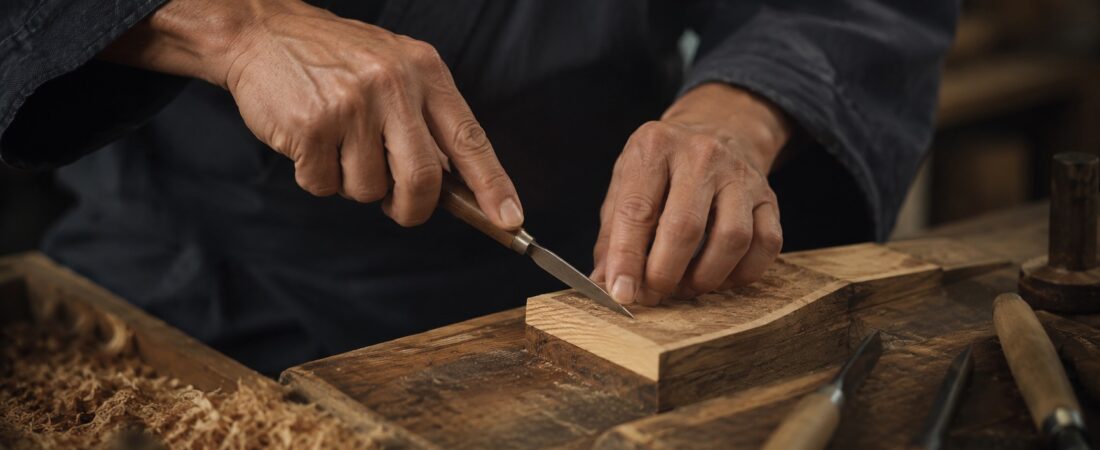
This is why the romantic image of the Japanese craftsman is so powerful. It gives the viewer something beautiful to believe in. A person in an apron, surrounded by tools, working silently in a narrow workshop, doing what their teacher did and their teacher’s teacher did before them.
It looks like depth.
Sometimes it is.
Sometimes it is only continuity wearing the costume of depth.
Why this matters to me personally.
I am not a craftsman.
But I have been taught by craftsmen, and I have spent enough time trying to learn skills with my hands to understand what genuine mastery feels like from the inside — and what it does not.
What bothers me is not that mediocre work exists. Mediocre work exists everywhere.
What bothers me is that in Japan, the label shokunin can be applied so broadly that the truly exceptional and the merely experienced are placed under the same word. The real masters end up sharing a title with people who have done the same adequate thing for a very long time.
That is not fair to the real masters.
And it is not honest about what craftsmanship actually is.
The best craftsmen I have met were not simply people who had repeated something for years. They had a relationship with the material. They noticed things other people missed. They could adjust before a mistake became visible. They could explain, demonstrate, or at least reveal through their hands that there was understanding underneath the movement.
They did not just inherit a method.
They understood why the method existed.
What real craftsmanship looks like.
The craftsmen I respect most — in construction, in trades, in the workshops I have spent time in — were people who could answer the question “why.”
Not always in words. Sometimes the answer was a demonstration. A small adjustment. A finger pointing to the grain, the angle, the resistance of the material. A pause before changing pressure. A correction so small that a beginner would not even notice it.
But there was an answer.
There was understanding underneath the technique.
That understanding is what separates a craftsman from someone who has simply been doing the same thing for a long time.
Japan has all three types: the real masters, the curious craftsmen who push the tradition forward, and the practiced imitators who reproduce what they were taught without fully understanding it.
It calls them by the same name.
And that, I think, is a quiet injustice to the ones who actually deserve the title.
All of the above is one Japanese person’s interpretation. Treat it accordingly.



Leave a Reply