
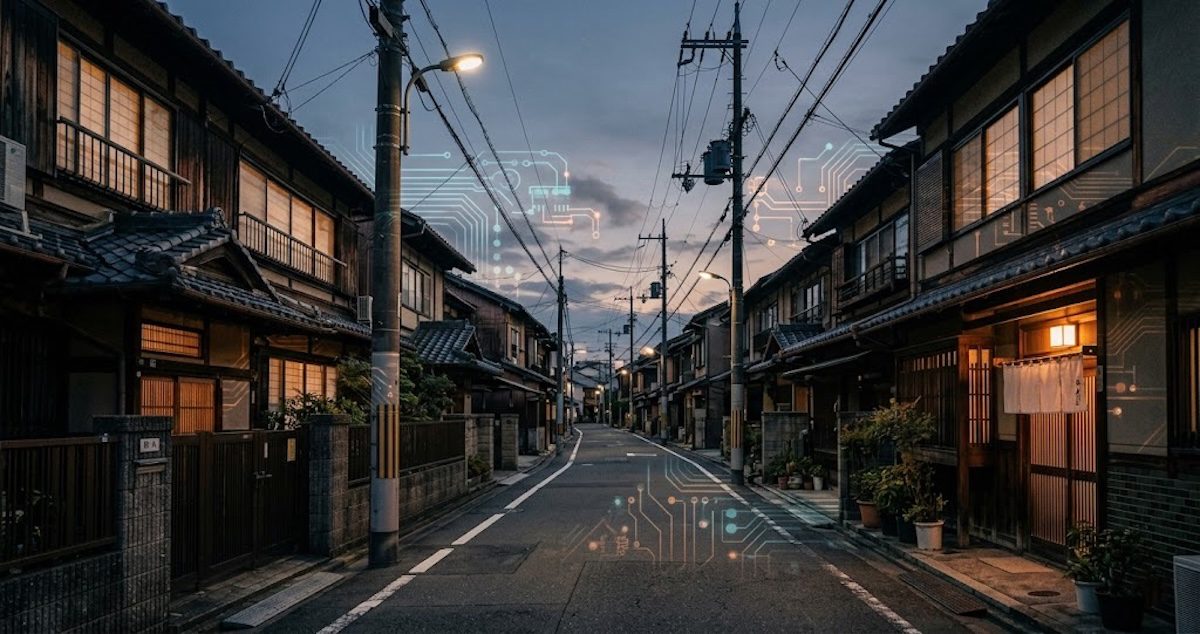
The confusing part about Japan is not that it lacks rules.
Japan has rules for everything.
Where to stand on the train platform. How to separate your trash. How to hand over cash at a convenience store. How to write an email. How to bow. How to apologize. How to enter a room. How to leave one.
This page is a map of Japan’s invisible rules — the ones that shape work, relationships, silence, politeness, and everyday life, but are rarely explained directly.
Japan can look, from the outside, like one of the most organized societies on earth.
And in many ways, it is.
But the most important rules are often the ones nobody explains.
The manual disappears where people begin.
Japan is not difficult because it is chaotic. It is difficult because it is organized around things that are not written down.
The train platform tells you where to stand. The restaurant tells you where to line up. The office has forms, procedures, meetings, approval routes, and documents for almost everything.
Then you enter a human relationship, and the manual disappears.
When should you speak in a meeting? When should you stay quiet? When does silence mean agreement, and when does it mean resistance? When is “we will consider it” a genuine possibility, and when is it a refusal wearing a polite coat? When is an apology about guilt, and when is it simply smoothing the room back into place?
Nobody hands you a rulebook for this.
Japanese people are not usually hiding the rulebook from you. In many cases, they do not think of it as a rulebook at all.
It is just how things work.
Japan is not just a high-context culture.
People often describe Japan as a high-context culture.
That is true, but it does not go far enough.
High-context cultures exist all over the world. Families are high-context. Villages are high-context. Religious communities, old neighborhoods, immigrant communities, military units, sports teams, traditional craft worlds — all of them run partly on things that do not need to be said because everyone involved is assumed to already understand them.
Japan is different because that high-context social operating system runs inside one of the most modern, organized, and verbally sophisticated societies in the world.
That is what makes it confusing.
This is not a remote village where everyone knows everyone and nothing is written down. This is a country of bullet trains, convenience stores, insurance forms, school systems, manuals, punctual delivery windows, and companies with five layers of approval for a single document.
The surface is modern.
The infrastructure is precise.
The language is capable of extraordinary subtlety.
And still, many of the most important social rules are transmitted through atmosphere, timing, discomfort, silence, and the fear of causing trouble.
That combination is very Japanese.
Japanese is not vague because it is simple.
Foreigners sometimes think Japanese communication is vague because Japanese people are avoiding clarity.
That is partly true. But it is also too simple.
Japanese can be incredibly precise. It can mark hierarchy, distance, politeness, softness, obligation, hesitation, and emotional temperature in ways English often cannot. A small change in phrasing can move a sentence from friendly to formal, from direct to indirect, from acceptable to rude.
The language is not weak.
It is extremely sensitive.
But that sensitivity is not always used to make things clearer. Sometimes it is used to avoid making things too clear.
A sentence like “That may be difficult” can mean many things depending on who says it, where, when, with what face, after what silence, and in front of whom. It may mean “This is difficult.” It may mean “No.” It may mean “Please understand that I cannot say no directly.” It may mean “If you keep pushing, you will become the problem.”
The words are only part of the message.
The rest is carried by the room.
Japanese people learn the system before they learn to explain it.
This is why Japanese people often struggle to explain Japan.
Not because they are hiding something. Not because they do not care. Not because they enjoy watching foreigners misunderstand things.
Because much of the system was installed before they had words for it.
At home, you learn not to cause meiwaku — trouble for others. At school, you learn to move with the group. In club activities, you learn hierarchy, endurance, silence, and reading the mood. In the workplace, you learn that saying the correct thing at the wrong moment can still be wrong.
You learn futsuu, ordinary. You learn hitonami, being in line with others. You learn kuuki wo yomu, reading the air. You learn tatemae and honne, what is said and what is felt. You learn that apology is not always about guilt. You learn that not saying no can be a form of social management. You learn that sometimes the person who speaks the truth becomes the problem because they changed the atmosphere.
Most of this is not taught as theory.
It is absorbed.
By the time you are an adult, it feels less like culture and more like gravity.
So when a foreigner asks, “Why do Japanese people do this?” the honest answer is often difficult.
Because Japanese people were rarely asked to explain the operating system.
They were asked to run it.
Foreigners can live in Japan for years and still miss the center.
This is not an insult. It is just the structure of the problem.
A foreigner can live in Japan for ten years, speak Japanese, marry into a Japanese family, work in a Japanese company, and still feel that something important remains just out of reach.
They may understand the words. They may understand the etiquette. They may know when to bow, when to bring omiyage, how to use sumimasen, how to survive a nomikai, how to avoid being obviously rude.
But that is not the same as understanding the invisible calculation underneath.
What will this do to the room?
Who will feel exposed?
Whose position will be disturbed?
Does this look normal?
Will this make someone lose face?
Is this technically correct but socially impossible?
Will saying the thing solve the problem, or create a new one?
These are not questions most Japanese people consciously ask themselves every second. That is the point. The system works because it has become instinct.
For someone who did not grow up inside it, learning the visible rules is possible.
Learning the instinct is much harder.
The strange part is that Japan often looks easier than it is.
Some countries look difficult from the outside. The language is unfamiliar. The infrastructure is confusing. The rules are loose. Things do not work the way visitors expect.
Japan is different.
Japan often looks easy.
The trains work. The streets are safe. The staff are polite. The vending machines are everywhere. The signs are clear. The food is reliable. The service is consistent. The city appears legible.
That is why the confusion can take longer to appear.
At first, Japan feels wonderfully organized.
Then, slowly, you realize that the most difficult parts are not the systems you can see. They are the expectations underneath them.
The problem is not buying a train ticket.
The problem is understanding why nobody objected in the meeting and then the project died later.
The problem is not learning the word sumimasen.
The problem is knowing whether the apology means guilt, gratitude, disturbance, obligation, or simply a desire to close the situation.
The problem is not knowing that Japanese people value harmony.
The problem is understanding how much damage can be done in the name of preserving it.
This is why JAPAN, honestly exists.
I do not think Japan is impossible to understand.
But I do think the parts that matter most are rarely the parts someone explains to you.
They are the parts you are expected to already know.
That is why many explanations of Japan feel incomplete. Travel guides explain the visible rules. Business guides explain the etiquette. Academic books explain the concepts. Foreign residents explain what Japan looks like from the outside.
All of those can be useful.
But there is another layer: the everyday operating system Japanese people grow up inside, rarely name, often obey, sometimes suffer under, and usually struggle to explain.
That is the layer I am interested in.
Not because I stand outside Japan.
Because I do not.
I was born here. I was raised here. I still live here.
But I have spent most of my life feeling that many parts of Japan did not quite make sense to me. I learned the rules, but I did not always stop questioning them. I worked for years between Japanese workplaces and foreign expectations, watching both sides misunderstand each other in ways that were predictable, painful, and often avoidable.
That is the position this site comes from.
Inside enough to know the pressure.
Outside enough to keep asking why.
The rules are real, even when nobody writes them down.
Japan’s invisible operating system is not one thing.
It is the air in a meeting. The apology that is not quite an apology. The silence that is not quite agreement. The “normal” that ends a conversation. The resume gap that looks like a broken line. The worker judged by presence rather than performance. The grief that must take the correct shape. The foreigner who is included, but not quite inside.
Each one looks small on its own.
Together, they form a world.
That world is not always fair. It is not always rational. It is not always cruel either. Sometimes it protects people. Sometimes it makes life smoother. Sometimes it helps a crowded society function without constant open conflict.
And sometimes it makes honest communication nearly impossible.
That is why it deserves to be explained.
Not to attack Japan.
Not to romanticize it.
But because many people live inside this system without knowing how to describe it, and many others encounter it without understanding what they are touching.
Japan does not always make sense.
That does not mean there is no logic.
It means the logic is often running underneath the words.
If you want to know who is behind this site, the About page explains that part.
All of the above is one Japanese person’s interpretation. Treat it accordingly.
Not sure where to go next?
JAPAN, honestly is now organized into reading paths based on what you are trying to understand: work, social pressure, daily life, language, outsiders, and deeper cultural ideas.
Explore the paths here: