
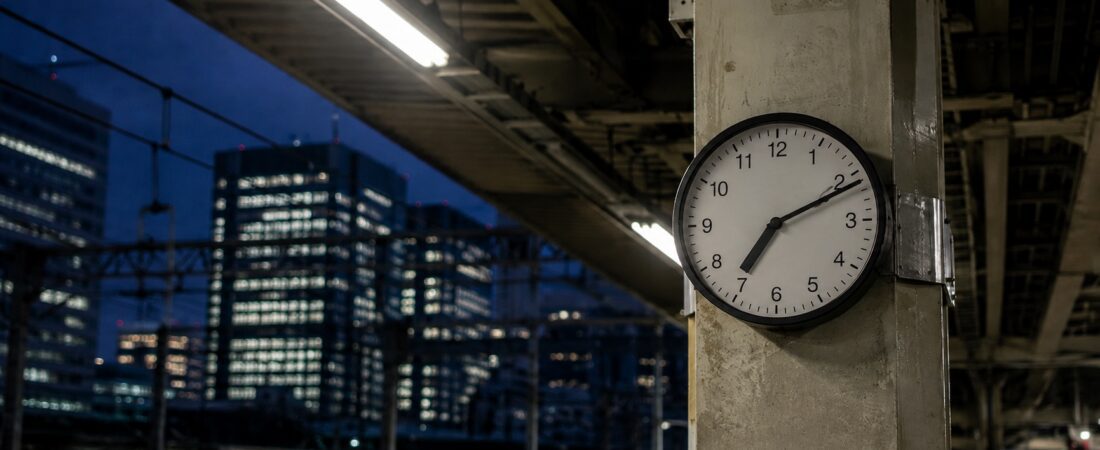
Are Japanese People Really Strict About “Time”?
The clock is doing more than one job
I think I am impatient.
But not in the simple sense.
I can sit still. I can make things. I can spend time on something that needs time. I am not always looking for the shortest route.
I do not mind time passing. I mind time going nowhere.
In traffic, I would rather take a longer road that keeps moving than sit on the shortest road that does not. That may not be impatience exactly. It may be an allergy to pointless stillness.
Then I look at the country I grew up in, and the story gets complicated. Japan is supposed to be patient — careful order, polite queues, trains whose delays are announced almost before anyone has had time to complain. And yet I have watched this same society react sharply to a two-minute delay in one room, and sit calmly with a two-year delay in another.
So maybe the question is not whether I am impatient, or whether Japan is patient.
Maybe the question is what kind of time we are talking about.
One Clock, Many Jobs
Japanese people are often described as punctual, or strict about time. That description is not wrong. It is just too simple.
In Japan, time rarely measures only time. Depending on where it sits, it can measure attitude, respect, readiness, hierarchy, permission, fairness, predictability, responsibility, resignation — or whether you understand the room you are standing in.
None of this is unique to Japan. Every culture loads time with meaning beyond the clock. Arriving late reads as disrespect in plenty of countries. Missing a deadline damages trust in any office. Cutting into someone else’s schedule is rude almost everywhere.
The difference is not that Japan attaches meaning to time while other places do not. The difference is which meaning gets the loudest voice in the room — and that voice changes by situation, sometimes inside the same afternoon.
This is also why some Japanese “rules” are hard to locate. They are not always written as rules. Sometimes they are stored in timing, posture, and the way people enter or leave a room.
Boundary or Signal
In the international business rooms I have worked in, time often behaved more like a boundary. A meeting from 10:00 to 11:00 belonged to that hour. Running past 11:00 meant taking something that belonged to someone else’s calendar.
In Japan, time often behaves more like a signal. Arriving on time announces attitude. Arriving early announces readiness. Arriving late announces something closer to disrespect, before anyone has said a word.
But the signal is not symmetrical. Starting on time is enforced with real social force. Ending on time is not enforced with anything like the same force, because the ending depends on hierarchy, atmosphere, unresolved discussion, and whether anyone in the room has the standing to close it.
This is not one set of rooms against another. It is a difference in which half of the clock carries the weight.
Walking In Late
Being late to a meeting in Japan is rarely just being late. It reads as unprepared, careless, or not properly present before you have contributed anything.
Japanese punctuality is not always about time. Sometimes it measures whether you understand the room.
Arriving on time, or a few minutes early, is not just a courtesy. It is part of how you enter the room. Arrive late, and whatever you say afterward has to work twice as hard to sound the same.
The Meeting That Does Not End
Japanese meetings tend to start on time and end whenever the room decides it is finished. The scheduled end is more often a suggestion than a deadline.
A Japanese meeting often has a start time, but not always an ending design. There is rarely an owner of the clock, a forced decision point, or someone with the explicit standing to say, “we stop here, regardless of what is unresolved.”
Plenty of people in that room know it is running over. Plenty of them know it is taking time from whatever comes next, for everyone present. The problem is not that Japanese people cannot understand time theft. The problem is that noticing it and being allowed to stop it are two different things.
When the room does not protect the ending time, the cost does not disappear. It simply moves downstream, often into someone else’s evening.
Technically On Time
Clocking in one minute before a shift starts is, by the clock, on time. In a lot of Japanese workplaces, it can still be read as barely making it — arriving with no margin, which becomes its own statement about how seriously you take the job.
This is not really about the clock. It is about how you enter the room: rushed and just-in-time, or settled before the first minute counts.
Leaving On Time
This one is shifting, and it would be dishonest to write as if nothing has changed. Some newer workplaces, and some industries, now treat leaving on time as ordinary.
But in plenty of offices, the social reading has not caught up with the policy. Leaving the moment the clock allows can still register as cold or not fully invested, while staying late — even unproductively — can still look like commitment. The boundary exists on paper. The signal underneath it is still being renegotiated.
The Three-Minute Delay
A train running a few minutes late can produce a frustration that looks disproportionate from outside. It is not really about three minutes.
Daily life in Japan is built on the assumption that the train will work, to the minute, every day. That assumption holds together a stack of other plans behind it — connections, meetings, the rest of the schedule. A small delay does not just cost three minutes. It costs a sliver of trust in a system everyone has quietly agreed to depend on completely.
What the Deadline Costs
Deadlines carry weight in Japan because they touch someone else’s schedule and trust, not just your own task list. Missing one rarely stays contained to you.
What gets hidden is what the deadline costs on the inside. External deadlines are often protected by quietly sacrificing the time of the people behind them. The deadline is protected. The people protecting it are not always protected.
This is one reason Japanese workplaces can look more functional than they really are: weak systems are often subsidized by human effort.
Not a Taxonomy
The point of going case by case is not to build a perfect taxonomy of Japanese time. Real life is messier than that. The point is simpler: the same clock can be used to judge very different things.
Reply Now, But Carefully
A slow reply can read as low priority, or as not taking the relationship seriously. So far, this is not so different from anywhere else.
What is sharper in Japan is the second pressure stacked on top: a careless reply can be worse than a slow one. Speed shows you noticed. Care shows you respect the relationship. Japanese communication can quietly demand both at once, which is a narrower target than it sounds.
Making Someone Wait
Showing up late to meet a friend hands them your lack of planning to carry for however many minutes you make them wait. That part is universal.
What stands out in Japan is the second half: the person who is late is judged. The person who waits is expected to endure it politely, without complaint, often without mentioning it afterward at all.
The Line Holds
People in Japan will hold a line for a remarkably long time without visible irritation — as long as the line is fair. Everyone entered in order, everyone moves in order, no one’s time outranks anyone else’s.
Cutting in is a different category of offense entirely. The complaint was never about waiting. It is about whether the waiting is being distributed evenly.
Waiting You Can See
A long wait at a restaurant is tolerable when the reason is visible — the kitchen is clearly busy, the staff are clearly moving. An unexplained wait, where nothing seems to be happening, produces irritation fast.
The complaint is rarely about the minutes. It is about whether the process still looks competent while those minutes pass.
The System Wins
People can sit in a hospital waiting room or a city office for hours and describe it afterward almost neutrally. That is not always patience.
It can be resignation toward a system the individual does not feel any power to move. Waiting becomes closer to acceptance than virtue — the time is gone either way, so minding stops being useful.
Not Yet
This is where the pattern flips hardest. A two-minute delay to a meeting gets noticed immediately. A two-year delay to a promotion, a restructuring, or a decision everyone privately agrees is overdue can survive without much resistance at all.
A late train has an operator. A late meeting has a room. A delayed structural decision often has no single owner at all. Everyone can feel the delay, but no one clearly owns the clock.
“Not yet.” “It is not the right timing.” “There is an order to these things.” “The top has to decide.” These phrases work a little like futsuu: they do not always explain the decision, but they can make questioning it feel out of place. Each phrase sounds reasonable on its own. Stacked over years, they add up to a patience that looks a lot like permanent postponement. The same culture that cannot tolerate a late train can sit with an unresolved structural problem for a decade.
Time as Proof
In training, craft, and club culture, time spent becomes evidence of seriousness on its own. Staying with something for years earns a kind of respect that shortcuts do not.
This produces real discipline and real depth — it is not a hollow tradition. But it also makes efficiency look slightly suspect, and early talent look a little like cheating. If something took you less time than it took everyone else, the room may wonder what you skipped, rather than what you understood faster.
This is also why the Japanese image of the shokunin can be so powerful — and so easy to misunderstand. Craft matters, but time spent is not always the same as purpose preserved.
So, Strict About Time?
So are Japanese people strict about time?
Yes — sometimes.
But that answer is too simple, and I no longer trust simple answers about this, including my own.
In Japan, time can measure attitude. It can measure respect. It can measure fairness. It can measure trust. It can measure whether a system is still predictable enough to lean on. And it can just as easily disappear into hierarchy, atmosphere, resignation, and the quiet belief that some things simply take the time they take.
That is why the same country can look impatient in one room and endlessly patient in the next.
I still think I am impatient. But I also make things, and making things requires patience. You wait for the material. You wait for the shape to settle. You wait until the thing tells you what it is becoming.
So maybe I am not impatient with time itself.
Maybe I am impatient with time that has lost its purpose.
All of the above is one Japanese person’s interpretation. Treat it accordingly.


Leave a Reply