
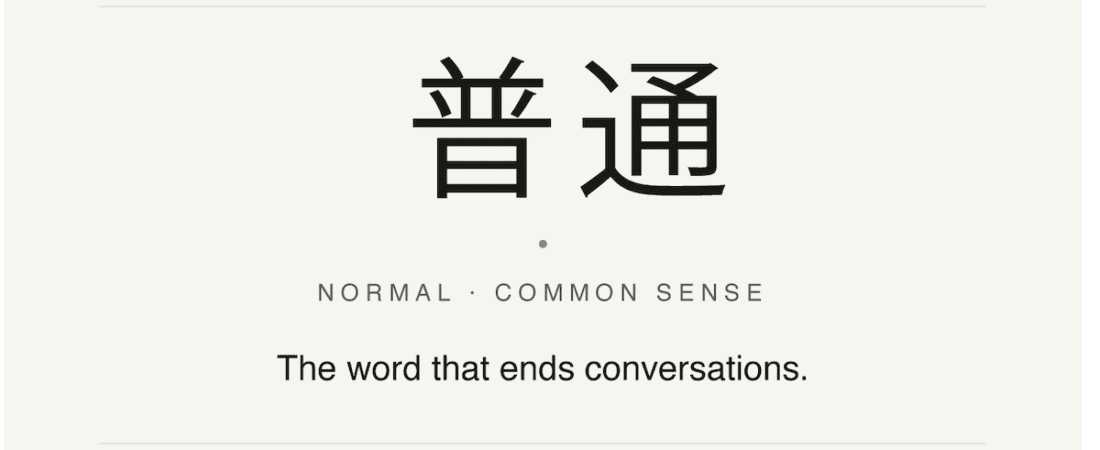
Futsuu: The Japanese Word That Ends Conversations
Why “normal” in Japan often means more than ordinary
There is a Japanese word that looks harmless at first. Futsuu. It is usually translated as “normal.” But in real conversations, it can do much more than describe what is ordinary. Sometimes, it ends the conversation before the conversation has really begun.
It Sounds Like a Question. It Functions Like a Statement.
One common phrase in Japanese is: Futsuu, kou dayo ne.
Roughly translated, it means: “Normally, it’s like this, right?”
That translation is useful, but it is also too weak. Futsuu, kou dayo ne does not always sound like a real question in Japanese. In many situations, it functions more like a conclusion. The speaker is not always asking for your opinion. They are often placing the answer in the room and inviting you to agree with it.
That small difference matters. Once something is called futsuu, the burden quietly moves. Not to the person making the claim, but to the person questioning it.
If you disagree, you now have to explain why your version of normal is different. You may also have to explain why you are making the room put into words what it expected to leave unspoken.
The word does not need to be aggressive to have power. That is exactly why it works.
Nobody Is Trying to Pressure You. That Is the Interesting Part.
When people talk about Japan, they often use the phrase “peer pressure.” I understand why. From the outside, it can feel like pressure. You are expected to match the group, read the room, avoid creating unnecessary friction, and understand what is not being said.
But I do not think “peer pressure” always explains what is happening. Pressure sounds intentional. It sounds as if someone is pushing you.
With futsuu, the person using the word may not feel that they are pressuring anyone at all. From their side, they may simply be referring to reality.
“Isn’t this obvious?” “Isn’t this how people usually do it?” “Isn’t this what everyone here understands?”
That is what makes the word interesting. The pressure is not always in the intention. It is in the shared premise.
If the premise is shared, futsuu feels efficient. It saves time. No one has to explain every small thing. If the premise is not shared, futsuu becomes a wall.
One side feels, “Nobody is forcing you.” The other side feels, “But I am being asked to accept something that was never explained.” Both reactions make sense. That is the part many explanations miss.
The Assumption Behind Futsuu
Futsuu is usually translated as “normal.” But in actual Japanese life, it often feels closer to “common sense,” or “what people in the room are expected to already understand.”
The strange part is that it is not exactly common sense either. Common sense sounds universal. Futsuu is more local than that.
It does not always mean “everyone in the world knows this.” It often means something closer to: “Everyone around here understands this.” Or: “People like us already know this.”
That hidden boundary is important. The word does not simply describe behavior. It quietly defines who is inside the shared context and who is outside it.
If you understand the futsuu, you are treated as someone who gets it. If you do not, you become the one who needs explanation.
That is why futsuu can feel so small and so heavy at the same time.
The Collective Becomes the Shield
The most powerful thing about futsuu is that it does not sound personal. If someone says, “I want it this way,” you can challenge them. Why? For what reason? Based on what standard?
But if someone says, “Normally, it is done this way,” the speaker disappears behind the collective. It is no longer one person’s preference. It becomes “how things are.”
That shift protects the speaker, often without the speaker realizing it. They no longer have to fully own the claim. The claim is carried by the invisible group.
This is why futsuu can stop conversations so effectively. It does not argue. It relocates the argument.
The question is no longer, “Is this the best way?” The question becomes, “Why don’t you already know this?”
The Cost of Explaining What Was Supposed to Be Obvious
In daily life, and sometimes at work too, this creates a very specific cost. Once futsuu no longer closes the gap, people have to explain what used to be left undefined.
They have to explain why something feels rude. Why a certain timing feels wrong. Why one way of speaking feels natural and another feels strange. Why “that is not how people usually do it.”
That is not always a bad thing. Sometimes it is necessary. But it changes the room. A shared world that used to run on unspoken assumptions suddenly requires language.
This is where Japanese communication can get stuck. Not because Japanese people cannot explain. Not because foreigners ask too many questions. But because the room was designed around a different operating system.
For a long time, many Japanese situations could move without defining everything. People knew the expected distance. They knew when something was too much. They knew when a response was too direct, when silence meant hesitation, when a casual phrase was not really casual.
Or at least, they believed everyone knew.
When that belief breaks, the old shortcut stops working. Then every shortcut becomes a small negotiation. That is the real pain. Not diversity as a slogan. Not globalization as a nice story.
The pain is that ordinary life becomes heavier when shared premises can no longer be assumed.
When Shared Assumptions Stop Being Shared
This is not only a foreigner versus Japanese issue. It also happens inside Japan. Between older and younger people. Between people raised in different regions. Between families with different rules. Between people who have spent their lives inside Japanese social expectations and people who have always felt slightly outside them.
The more mixed the room becomes, the less reliable futsuu becomes.
In the past, Japan had many systems that made shared assumptions easier to maintain. Similar schools. Similar entrance exams. Similar company training. Similar hiring routes. A smaller number of television channels. Similar ideas about what a “proper” person should notice without being told.
Of course, having fewer television channels was not unique to Japan. Other countries had that too. The difference, at least from where I stand, is that Japan had fewer everyday chances to check whether the assumption was really shared.
People could live for a long time inside a world where the same manners, the same timing, the same phrases, and the same sense of “that is obvious” kept being repeated back to them.
So the problem was not simply that everyone received the same information. The problem was that the sameness was rarely tested.
This is closely connected to the Japanese idea of reading the air. In another article, I wrote about whether Japanese people can still read the same air. The question is not only whether people can read the room. It is whether the room is still shared enough to be read in the same way.
Today, that shared room is harder to assume. People do not follow the same path. They do not receive the same information. They do not always accept that age, silence, politeness, timing, or vague hints should carry the same meaning.
So when someone says futsuu, the word still carries weight. But the foundation under it is less stable. The room does not always know which “normal” is being used.
The Word Still Works
This does not mean futsuu has disappeared. It still works. In many Japanese conversations, it works very well. That is why people keep using it.
It is efficient. It compresses context. It avoids direct confrontation. It lets people move without spelling out every rule.
A society cannot function if everything has to be explained from zero every time. Shared assumptions are not automatically bad. They are part of how any group works.
The problem begins when people forget that the assumption is an assumption. That is when futsuu stops being a useful shortcut and becomes a way to avoid explanation.
It turns a local premise into reality. It turns a preference into common sense. It turns “this is how we usually do it here” into “this is how things are.”
That is why the word matters. Not because Japan is uniquely mysterious. Not because Japanese people are secretly trying to control everyone. But because futsuu shows how much Japanese communication has depended on shared premises doing invisible work.
When those premises are shared, the room moves quickly. When they are not shared, the room does not simply become more diverse. It becomes more expensive to live inside.
Everything that used to be understood has to be said. Everything that used to be assumed has to be negotiated.
And every time someone says “normally,” the real question is:
Normal for whom?
All of the above is one Japanese person’s interpretation. Treat it accordingly.



Leave a Reply