
Being Japanese Is Not Structural Engineering
What a beautiful story about Japanese wood quietly left out
I recently read a version of this sentence in an article: Japan has trusted wood for 1,300 years.
It’s a good sentence. It’s also doing more work than it should.
The Argument, Fairly Stated
I recently read an English-language article, written by a Japanese writer, that went roughly like this. Japan has trusted wood for thirteen centuries. Its oldest wooden temples are still standing, proof of a civilization that never stopped believing in timber. The piece is honest about the gap in the middle — for most of the postwar era, Japan rebuilt its cities almost entirely in concrete and steel, and wood was quietly set aside. But that old confidence, the argument goes, never really disappeared. It’s continuing now, in the new generation of tall wooden buildings rising in Japanese cities. Wood stores carbon, so building with it is a climate strategy, not just an aesthetic one. Cut a mature tree, use it in a building, plant a new one, and the cycle renews itself. Japan’s old wisdom about wood, the argument goes, may hold answers for the future.
It’s a well-built piece. Clean structure, confident voice, genuinely readable. My problem is not with the writing itself. My problem is with what the writing quietly assumes.
What’s Actually True
Japan does have a real, long relationship with wood. Temple carpentry, joinery without nails, the sensitivity to grain and texture in a tea room, the wooden interiors that make a space feel a certain way to sit in — none of that is invented. It’s craft knowledge built up over centuries, and it’s still visible in how Japanese builders and clients think about material. I’m not disputing that Japan has wood in its bones.
What I’m disputing is the next move: sliding from that lived culture straight into modern timber high-rise engineering, as if one explains the other.
Where the Story Breaks
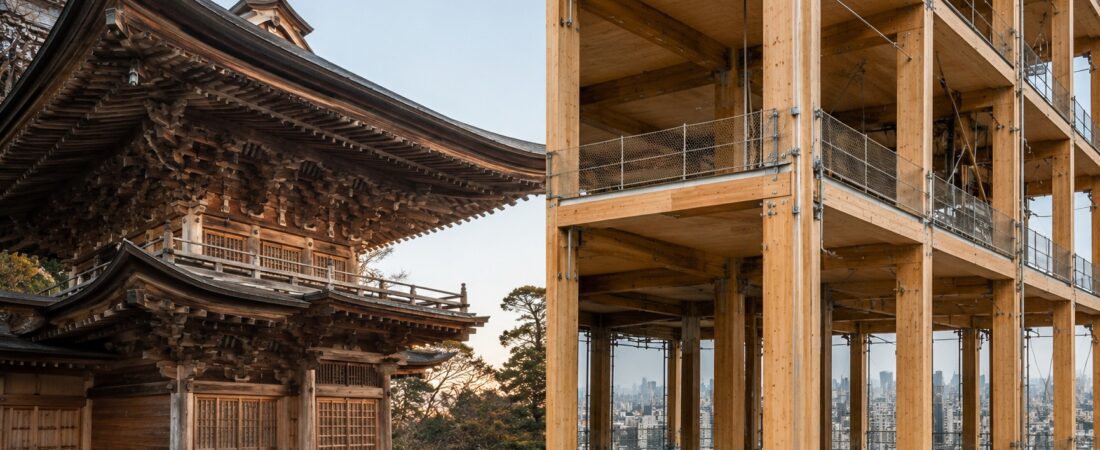
A temple standing for a thousand years and a fourteen-story timber office tower are not the same kind of achievement, and treating them as one continuous story flattens both.
The temple is solid timber, carpentry, joints, low buildings, and a culture of ongoing repair — parts get replaced generation after generation, which is itself a different relationship to permanence.
The tower is glulam and cross-laminated timber, industrial adhesives, steel connectors, fire-resistance engineering, seismic calculation, building code compliance, and lifecycle carbon accounting. None of the engineering ecosystem that makes today’s timber high-rises possible existed 1,300 years ago. Much of it has matured only in recent decades.
And none of it is uniquely Japanese, either. Timber high-rise engineering is a shared, global research effort — the same push is underway right now in Canada, Austria, Norway, Sweden, the UK, and Australia, among others. What Japan brings to that effort isn’t ownership of the technology. It’s its own body of expertise inside a field the entire world is working on at once. That also complicates any headline crediting one country with inventing wooden architecture and now reinventing it — timber building has separate, equally old lineages in China and Scandinavia, among other regions.
Wood Never Left
In fact, Japan never stopped using wood. Houses. Schools. Interiors. Public buildings. Furniture. Traditional architecture. Concrete buildings with exposed timber finishes. Wood did not disappear, and it never needed rediscovering.
What did shrink, for several postwar decades, was wood’s place in the skyline. Cities were rebuilt largely in concrete and steel, fire codes leaned against timber, and Japan’s own domestic timber self-sufficiency fell to around thirty percent even as the country stayed one of the most forested nations on earth. That’s a real story. But “wood left the skyline” and “wood left Japan” are two different claims, and the beautiful version tends to slide from the first into the second.
The question was never whether Japan should use wood again. The question was whether wood could enter places it had never been able to enter before.
What Actually Changed
The breakthrough is not cultural continuity. It’s applied structural engineering. Not that Japan kept trusting wood — that engineers changed what wood could be. Wood has been re-engineered to do things solid timber simply cannot do: span farther, carry more load, resist fire long enough to meet code, survive an earthquake in a fifteen-story frame. Crediting that to a thirteen-century tradition undersells the people who actually did the work — most of them alive right now, running calculations.
“Wood” Is Not One Material
Part of what makes the beautiful-story version so easy to write is that “wood” gets used as if it means one thing. It doesn’t. There’s structural wood carrying load. There’s finish wood you can touch. There’s decorative wood doing nothing but looking good. There’s wood as branding, wood as regional forestry policy, wood as a number in a carbon spreadsheet. These are different jobs, and a building can do some without doing others.
In actual projects, those distinctions matter. A client may say they want a “wooden” space, while the structural engineer, interior designer, fire consultant, and contractor may all hear something different in that one word. That is where a beautiful material story becomes a coordination problem.
Which raises a question the beautiful story skips: does a person standing inside a timber high-rise actually feel wood, the way they’d feel it in a temple or a well-built wooden house? Often, no. The structural timber often has to be protected behind fire-resistant layers or finishes. What the occupant sees is a veneer, a panel, a “wood-look” ceiling. Meanwhile a concrete building down the street might expose real wood beams, wood louvers, wood ceiling battens, and feel far more “wooden” to the person standing in it. Structural ambition and sensory experience are not the same axis, and conflating them is exactly how a technical building becomes a cultural fable.
Kuma Is Not Doing Nostalgia
Kengo Kuma gets cited a lot in these stories, usually as evidence that Japan is “returning” to wood. That reading undersells him. Kuma doesn’t use wood because Japan quietly went back to tradition. He uses wood the way Tadao Ando uses concrete — as an architectural weapon, deployed with full awareness of what tradition means and what it can be made to do differently. That’s not simple nostalgia. That’s a modern architectural language that happens to be built from an old material. Reducing it to “Japan trusts wood again” erases the actual authorship.
The Sustainability Circle That Isn’t
The cleanest part of the beautiful story is also the weakest: cut mature trees, build with them, plant new ones, cycle complete. On paper, sure. In practice, Japan’s forestry sector has a serious labor shortage, and a large share of postwar cedar and cypress plantations are undermanaged — planted, then left, because there weren’t enough people to thin them properly. Replanting isn’t automatic; it’s a decision someone has to make and fund. A new tree needs decades to reach usable size, and during those decades someone has to keep showing up to maintain the forest. Logging, drying, processing, and transport all burn carbon before a single beam is installed. The building itself has to last long enough to justify the embodied carbon, and what happens to the material at the end of its life matters just as much as how it started.
None of this means timber construction can’t be sustainable. It means sustainability here is a circle drawn on paper, and reality is labor, cost, maintenance, and people who keep showing up in the forest. Skip that part and you’ve written marketing, not analysis.
Why This Bothers Me
I’m not defending Japan reflexively here, and I’m not reacting as a fan of temples. I’ve spent years working around manufacturing and product development — wood processing is one part of that, and I’ve also been closely involved in architecture — and that’s enough to notice when a technically dense field gets quietly replaced by a nice narrative. That’s the actual frustration — not that a Japanese person wrote in English about Japan, but that being Japanese got treated as if it were the same as knowing the engineering.
It isn’t. Living inside a culture gives you the texture, the instinct, the felt sense of a material. It does not automatically give you the structural knowledge of how that material is being re-engineered by people in a completely different field. Those are different kinds of knowing, and the beautiful Japan story works precisely because readers can’t easily tell the difference from outside.
The Standard I’m Applying to Myself, Too
Here’s the uncomfortable part. The more foreign readers trust a piece because it’s written by a Japanese person, the more careful that person needs to be — and I include myself in that. Inside access is real, and it’s its own kind of expertise. It just isn’t structural engineering, and it should never be allowed to substitute for that.
So read this critically too. If I get a technical detail wrong, tell me. If I’ve cherry-picked to make a cleaner argument, point it out. If I’ve oversimplified Japan anywhere in this piece, challenge me on it. I’m not asking to be trusted because I’m Japanese. I’m asking to be corrected when I’m wrong, and I’d rather be known for accepting that than for sounding certain.
All of the above is one Japanese person’s interpretation. Treat it accordingly.



Leave a Reply