

Which Japanese People?
There is a version of Japan that circulates in English, and lately I find myself getting stuck on it.
It appears in business books, social media posts, cross-cultural training materials, and well-meaning explainer articles. It describes a country where people read the air, avoid direct confrontation, stay late out of loyalty, and say yes when they mean something else.
Some of this is recognizable. I have lived inside Japanese work culture for most of my adult life, and I can see where these descriptions come from.
But lately, when I read them, I find myself asking a question I did not used to ask.
Which Japanese people are we actually talking about?
The Japan That Explained Itself
There was a version of Japan where “Japanese people are…” made reasonable sense.
Not perfect sense. But reasonable sense.
Most people watched the same television programs. Went through the same education system. Graduated, joined a company, and stayed. The life script was not universal, but it was dominant enough that exceptions were legible as exceptions.
The shared assumptions were real. Not because every Japanese person was identical, but because the infrastructure of daily life — schools, companies, media, neighborhood associations — produced enough overlap that you could say “Japanese people tend to…” and not be completely wrong.
That Japan existed. I grew up in it.
The People Changed. The System Didn’t.
Something has shifted.
Younger Japanese people today are not following the same script. Some are joining startups. Some are working for foreign companies. Some are building careers around multiple income sources. The idea of staying at one company for thirty years is no longer the default assumption for most people under forty. Even the shape of personal life is changing — more people are delaying marriage, reconsidering it, or finding that the traditional model simply does not fit the life they are actually living.
The values have moved.
But the systems have not fully followed.
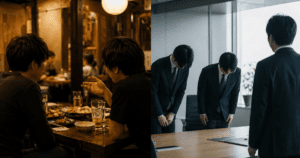
Walk into most Japanese companies today and you will still find meeting structures designed for consensus-before-discussion. Evaluation systems that reward presence over output. Hierarchies that assume seniority equals insight. Unwritten rules about when to speak, how to disagree, and what kinds of ambition are acceptable to display.
The people inside these systems are changing. The systems themselves are moving more slowly.
This creates something unusual. Not a Japan that has simply changed. A Japan where different versions of itself are operating at the same time.
The Generation in the Middle
I am in my forties. At least in my case, I feel like I belong to one of the last generations fully formed by the old Japan — and one of the first forced to function inside the new one.
I was educated in a system that valued conformity, endurance, and group harmony. I joined a large organization and learned its rules. I understood, from the inside, why people stayed late even when the work was finished. Why disagreement was expressed through silence rather than speech. Why being indispensable felt like security.
I also spent more than two decades working alongside foreign colleagues. I watched what happened when two different assumptions about communication entered the same room. I started asking questions that most people around me were not asking.
And somewhere in that process, I stopped being able to answer “Japanese people are…” with confidence.
Not because Japan had become incomprehensible. But because I had started to see which Japan I was actually describing whenever I said those words.
Was I describing my parents’ generation, which built the postwar system and still half-runs it? The generation that sacrificed personal time as a matter of course, and genuinely believed this was correct?
Was I describing my own generation — which inherited those values, and in many ways is already changing them in practice, but finds it difficult to shift the deeper habits that have accumulated over decades? The generation that can see what needs to change, but also knows how hard it is to move something that has been in place for that long?
Was I describing people in their twenties and thirties, who look at lifetime employment and company hanko the way I look at fax machines — as things that technically still exist, but no longer make sense as defaults?
These are not the same people. They are not even operating under the same assumptions.
Multiple Japans, One Label
What we call “Japanese people” is not one thing.
It is several generations with different formation experiences, different expectations, and different relationships to the same institutions — all currently operating inside a country that has not yet decided what it is becoming.
The older generation built the system. The middle generation is living inside it while already rewriting parts of it — quietly, incrementally, without the kind of dramatic break that would make the change visible from the outside. The younger generation is navigating it while looking for exits.
And yet, in conversations about Japan — whether in business books, social media posts, or casual explanations at dinner — we keep using the same sentence.
Japanese people are…
Sometimes this is a foreigner trying to make sense of a confusing experience. That is understandable. The surface of Japan can look very uniform from the outside.
But sometimes it is Japanese people explaining themselves. And that is where it gets interesting.
Because when a Japanese person in their forties tells a foreign colleague that “Japanese people don’t like direct feedback,” which Japanese people are they describing? Their own instincts, shaped by a system that is already changing? A generation younger than them, who might actually prefer directness but have learned to suppress it? Or a generation older than them, whose preferences are slowly becoming less relevant?
The explanation may be accurate. Or it may be a description of a Japan that is already partly gone — preserved in the language we use to explain ourselves, even as the reality underneath shifts.
Has Japan Changed?
Japan has changed. That much is not really in dispute.
But I am not sure the change is best described as Japan becoming more modern, or more Western, or less Japanese.
What I observe is something more specific. The assumptions that once held Japanese society together — about work, about loyalty, about the correct shape of a life — are no longer universally shared. But the institutions and explanations built on those assumptions are still largely in place.
The result is not a new Japan. It is multiple Japans, running in parallel, inside the same borders and often inside the same office.
When someone says “Japanese people are…”, they are usually describing one of these Japans. The question worth asking is which one.
Because the answer changes depending on who you are talking to, how old they are, where they work, and how closely their actual life resembles the script they were handed.
Japan is not a single thing that can be explained once and understood permanently.
It is a set of overlapping realities that are currently in the process of separating from each other.
And the sentence “Japanese people are…” has not quite caught up with that yet.
All of the above is one Japanese person’s interpretation. Treat it accordingly.


Leave a Reply