
Why Japanese People Are Polite Offline and Brutal Online. It’s the Same Reason.
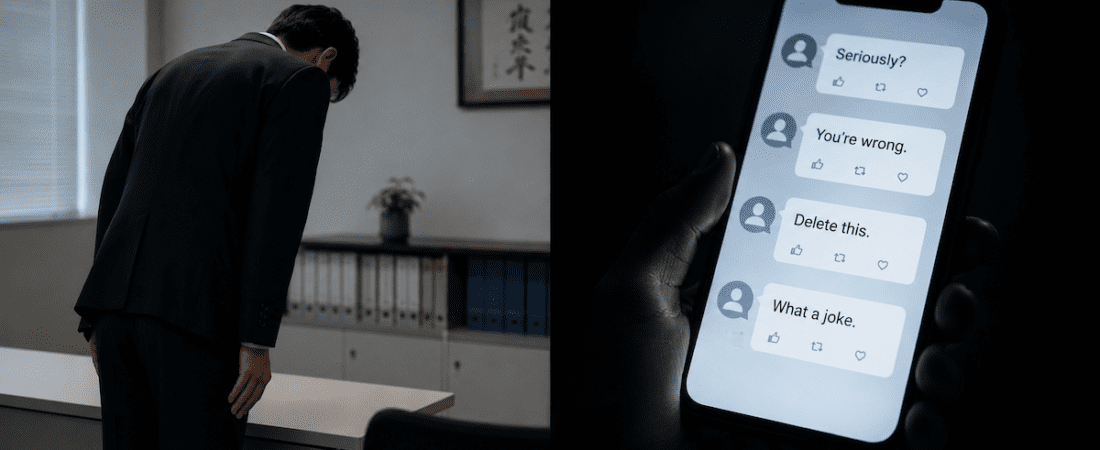
Spend enough time in Japan and you notice something. The person who bows at the convenience store, who apologizes when you bump into them, who wouldn’t dream of raising their voice in a meeting — that same person, given an anonymous account and a comment section, can be ferocious.
The same culture that produces extraordinary public courtesy also produces some of the most hostile corners of the internet. Yahoo Japan comments. 5channel. Anonymous Twitter accounts that exist for no apparent purpose other than to attack.
This isn’t a contradiction. It’s the same mechanism, running in opposite directions.
Two voices, one person.
Japan has a word for this duality: honne and tatemae.
Tatemae is what you show in public — the behavior, opinions, and tone that social harmony requires. Honne is what you actually think and feel. Every culture has some version of this gap between public and private. What makes Japan distinctive is how wide that gap tends to be, and how consistently it’s maintained.
In Japan, expressing your honne in the wrong context carries real costs. Say the wrong thing to the wrong person and you risk being judged, excluded, or remembered in ways that can follow you for years. In a society where group membership matters and where losing face is genuinely painful, the rational response is to keep the honne to yourself.
So most people do. In most situations.
The release valve.
Anonymity changes the equation entirely.
No face. No name. No traceable identity. No professional consequences. No social fallout. The pressure that keeps honne suppressed in daily life has nowhere to land.
This is not an accident. 2channel — now 5channel — became famous precisely because of this principle: anonymity allowed people to say what they actually thought, free from the social performance that real life requires. A space where honne could finally breathe.
What perhaps nobody anticipated — or perhaps understood perfectly — is that suppressed honne doesn’t just come out. It comes out at pressure. Years of careful public performance, followed by an anonymous text box and zero consequences, doesn’t produce measured discourse. It produces something rawer than that.
There’s a particular kind of hostility that shows up in Japanese comment sections that unsettles even people who know the culture well. It doesn’t always look like crude insults. Sometimes it’s written in perfectly polished keigo — formal, respectful Japanese — delivered with the measured tone of a courtroom. Grammatically flawless. Socially devastating. The register of public life, weaponized. A mock trial conducted in the language of politeness.
The argument problem.
There’s something woven into the very fabric of how we are taught to communicate.
In many English-speaking educational systems, students are at least more likely to encounter structured training in argument. How to construct a position. How to anticipate objections. How to disagree with an idea without attacking the person holding it. Persuasive writing. Debate. The assumption that having an opinion means being prepared to defend it.
In Japan, this training is largely absent. Debate exists at the university level, and in some high schools. But the idea that disagreement is a normal and healthy part of conversation is not something that most Japanese people absorb through their education. Disagreement, in the contexts most Japanese people navigate, tends to feel like conflict. And conflict tends to feel dangerous.
One study comparing Japanese students’ academic debates in Japanese and English suggested that the problem was not a lack of critical thinking itself. In Japanese, students could perform relatively well. The harder part was performing that thinking publicly — and the training to do it, in any language, had simply not been there.
This explains the exact same paralysis that happens when a Japanese person struggles to say “no” to a foreign boss. It’s not that the position is unavailable. It’s that expressing it clearly, without a structure for doing so, feels like launching an attack — or inviting one.
What happens when the training is absent and the pressure is off.
Put these two things together — years of suppressed honne and limited training in structured disagreement — and you get a specific kind of online behavior.
The argument doesn’t look like debate. It looks like a fight. Because the tools for debate — separating the idea from the person, building a case rather than attacking a position, engaging with what someone actually said rather than what you wanted them to say — aren’t available in the same way.
What’s available is the raw honne. The thing that’s been waiting. And without structure, it comes out as aggression.
This is what I see in Japanese comment sections. Not stupidity. Not malice, necessarily. Just honne, unmediated, in a space that has no social rules to shape it.
The silent majority.
Here’s what makes this more interesting, and more Japanese.
The loudest voices in Japan’s online spaces are not representative of most Japanese people. Online hostility tends to follow a familiar pattern: a small number of highly active accounts produce a disproportionate amount of the most extreme content, while the majority watches silently. That pattern has been observed across social platforms, and it fits what Japanese comment spaces often feel like from the inside.
Most Japanese people, online as offline, are watching. Not contributing. Not fighting. Observing.
This is the same pattern as in a Japanese meeting room. The space is dominated by a few voices — sometimes aggressive, sometimes simply confident — while the majority remains silent. Not because they have nothing to think. Because speaking carries risk, even when the space is nominally anonymous.
The silent majority is a concept that describes Japan well. Offline and online, it’s the same people. Staying quiet, watching the few who don’t.
The same reason.
The brutality and the politeness come from the same place: a culture where public expression is costly, where honne is carefully managed, and where the skills to express disagreement constructively have not been widely taught.
Remove the social cost — with anonymity — and the honne comes out. Without the tools to express it as argument, it comes out as attack.
Japanese people aren’t two-faced. They have one face, and two places to put it.
All of the above is one Japanese person’s interpretation. Treat it accordingly.


Leave a Reply