
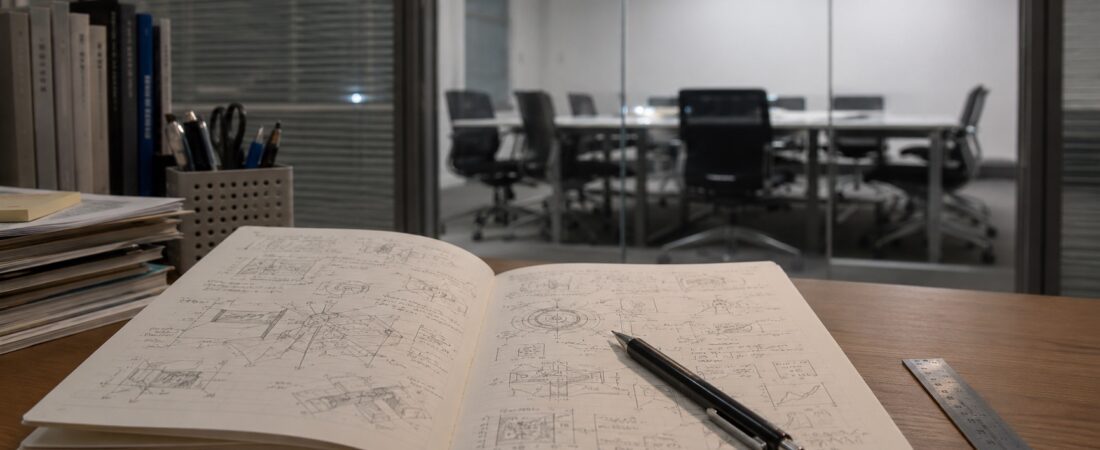
Japanese People Don’t Speak Up. So Where Does All That Self-Expression Go?
On expression, assertion, and where the energy actually goes
Japanese people do not express themselves.
Or at least, that is how they are often described from the outside. Japanese people do not speak up. They stay quiet in meetings. They avoid saying what they really think.
I thought about this recently in a casual conversation, partly because I had been reading Bleach, the manga, while it was temporarily available for free. So of course I read it.
And while reading it, I was reminded again how carefully Japanese manga often builds its worlds. Not just Bleach. Many manga and anime are drawn with a strange level of resolution: rules, hierarchies, emotional logic, invented systems, and small details that make a fictional world feel internally real.
So I do not think the problem is a lack of thinking. Or a lack of expression. Look at the manga, anime, games, craft, design, and obsessive product details Japan keeps producing. The ability is clearly there.
That is not really about manga. It is about where that kind of careful thinking becomes visible — and where it does not. It appears easily in private or self-contained forms, but becomes harder to see once other people, roles, responsibility, and work enter the room.
I have often seen Japanese colleagues say almost nothing in a meeting, then afterward, in casual conversation, say something like, “We should have done it this way,” or “That plan probably won’t work.”
My honest reaction is always the same: then say that in the meeting.
That is where the gap appears. Not in the ability to think. Not in the ability to create. The gap appears in connecting private thought to shared examination — and then, when necessary, to assertion.
Expression Is Not Assertion
The mistake is not that outside observers notice silence. They are right to notice it. The mistake is assuming that silence in the meeting means absence of opinion in the person.
The strange part is not that Japanese people have nothing to express. The strange part is that expression can remain private even when the work itself is public.
Work is public. Your output is seen, judged, and remembered. But in many Japanese workplaces, assertion still feels strangely private.
Saying “I think we should do this instead” in front of the group can feel less like professional contribution and more like bringing a personal opinion into a place where it does not quite belong. Nobody teaches this as a formal rule. People just learn it.
Outside observers tend to start from a rule they rarely state out loud: a good worker speaks up. If you see a problem, you say it, in the room, while there’s still time to fix it — and saying it is treated as proof that you were paying attention in the first place.
A lot of Japanese workplaces can run on a different unstated rule: a good worker fixes things without making a fuss about it. Announcing a problem in front of everyone can read less like initiative and more like making noise about something you should have just handled. The competent move isn’t to flag the issue out loud. It’s to correct it, and let the correction speak for itself.
Neither rule is written down anywhere. I’ve written before about how many of Japan’s rules are not written as rules at all, and this is another version of that problem. Both sides assume theirs is simply how a capable person behaves. So when someone from the outside watches a Japanese employee say nothing in a meeting, they are not only observing silence — they are applying a rule about what silence is supposed to mean, and the rule does not transfer.
Where Did All That Energy Go?
From the outside, the obvious question is “why don’t they speak up?” That’s a reasonable question on its own terms. It assumes that a real disagreement will eventually push itself into whatever room is available, because an opinion that strong doesn’t just sit still.
My question is different: where did all that energy go?
It’s not a lack of dedication. Plenty of the same people who say nothing when a plan is clearly flawed will go back to their desk afterward and quietly fix it anyway — staying late to correct a mistake nobody would have noticed if they hadn’t bothered.
Work dedication and workplace assertion are not the same thing. A person can care deeply about getting the work right and still never treat the meeting as the place where their opinion belongs.
For a lot of people, there’s a quiet calculation underneath: if I can fix it without making it a meeting issue, why make it a meeting issue? Flagging the problem out loud risks turning a five-minute fix into a half-hour discussion, a round of blame, or a debate about whose job it was to catch it in the first place. Just fixing it skips all of that. The immediate work gets done. Only one version of it leaves a record that you were the one who noticed.
None of that is absence. It’s just not aimed at the room.
The Room Is the Expensive Part
Speaking up in a meeting and quietly fixing the same problem afterward cost completely different things.
A meeting is live. What you say is attributed to you, in front of people who decide your evaluation, witnessed by colleagues who will remember it the next time something goes wrong. If your idea is good, you may now own its execution. If it’s bad, you own that too. There is no draft version of speaking. Once it’s out, it’s out.
Fixing the same problem quietly has none of that. Nobody decides whether it deserves the room’s attention. You control the pace, and whether anyone ever finds out it was you who caught it.
Kaizen teian — written improvement proposals, sometimes anonymous — is one example of this: a side channel for input that does not require anyone to raise a hand in front of the group.
I’ve written elsewhere about how the live meeting in Japan is often the last and least important stage of a decision that already happened somewhere quieter — that piece covers the nemawashi mechanics in more detail. What I’m pointing at here is where the dedication goes instead, not just why the room runs empty.
It’s Never Just One Reason
Some of it is the quiet-fixer logic already at work. But ask five people directly why they didn’t say anything in that meeting and you’ll get five different, only partly compatible answers, and most of them will sound smaller than “culture.”
Some of it is plain lack of confidence — not being fully sure your read of the problem is even right. Some of it is role: saying something can read as claiming a lane that wasn’t yours, the section chief’s call to make and not the new hire’s. Some of it is the ordinary fear of responsibility, since proposing something out loud can mean volunteering to own whatever happens to it. And a fair amount of it, more than anyone likes to admit in a business article, is plain Mendokusai — too much trouble for what it’s worth, given everything else already on the plate.
None of that is harmony. Harmony is too clean a word for a decision that’s usually closer to: this isn’t worth the cost of saying it here.
Maybe I Was Looking in the Wrong Place
I’m not arguing that Japanese people are secretly assertive and just hiding it well. That would just be the same flattering story told in reverse.
What I think is closer to true is that the working self and the asserting self were never taught to connect cleanly in the first place. That is why someone can fix the problem and still never bring it into the room. Nobody designed it that way on purpose — it settled into place, small reason by small reason, until the pattern looked deliberate. What needed to be said doesn’t disappear. It shows up somewhere else, in the extra hour nobody saw.
That’s not nothing. But it isn’t free either. The immediate problem gets fixed. The system does not. The meeting stays exactly as hollow as it looked, and a genuinely good idea stays private instead of becoming part of the plan.
I used to think the question was why people don’t speak up. I think now I was pointing the question at the wrong room.
The energy isn’t missing. It’s just somewhere else.
All of the above is one Japanese person’s interpretation. Treat it accordingly.



Leave a Reply