
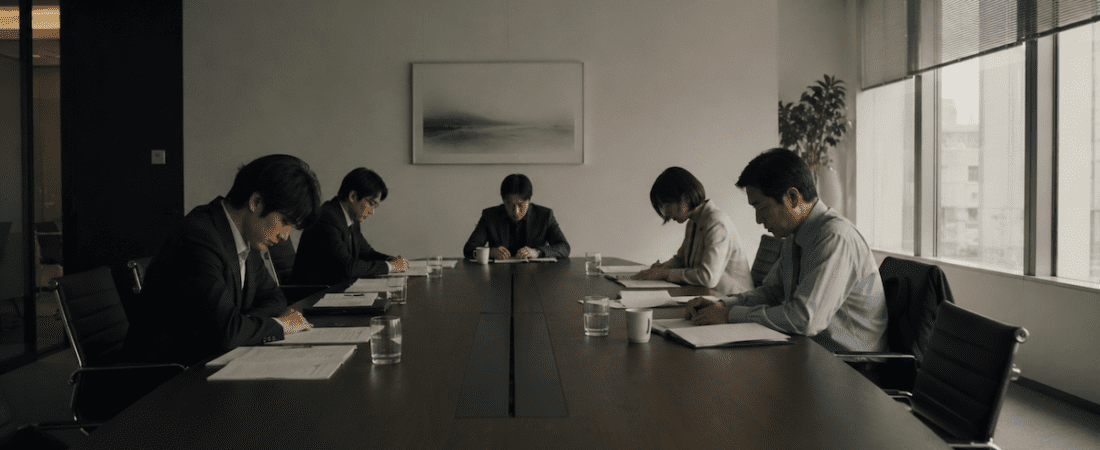
Nobody Speaks in Japanese Meetings. Something Is Still Being Decided.
If you’ve ever sat in a meeting in Japan and thought, “Why is nobody saying anything?” — you’re not alone. It’s one of the first things foreigners notice. And most of the explanations out there miss the point.
This isn’t only about harmony. It’s not just politeness. And it’s not because Japanese people don’t have opinions.
And for what it’s worth — a lot of Japanese people find meetings just as tedious as you do. They’d rather skip them too.
Here’s what’s actually going on.
The meeting already happened. You just weren’t there.
By the time everyone sits down in the conference room, the decision has often already been shaped — sometimes almost fully made. Not in secret, exactly — but not in the room either.
Japanese workplaces operate on a three-layer system that most foreigners never see.
The first layer is the review. Before anything goes near a formal meeting, the person responsible brings the proposal to their seniors — a design review, a content check, a sanity test. The point is simple: don’t bring something broken into a room full of stakeholders. Fix the obvious problems first.
The second layer is nemawashi — the part that gets written about endlessly in business culture articles. Informal, one-on-one conversations with key people before the meeting. Building quiet agreement in advance.
The third layer is the meeting itself. By this point, it’s essentially a formality. A public confirmation of what’s already been decided. In many Japanese organizations, the formal approval process — ringi — involves a document that circulates through relevant departments, collecting stamps (hanko) from each person along the way. The people sitting in the meeting room have often already pressed their seal to that document. The meeting is where that approval becomes visible.
Foreigners walk into layer three and wonder why nothing is happening. They missed layers one and two entirely.
This is also why decisions actually get made in Japan long before the formal meeting begins. The room is often not where the decision is born. It is where the decision becomes official.
Nemawashi isn’t harmony. It’s politics.
Every article about nemawashi describes it as a thoughtful, considerate way of building consensus. Rooted in gardening. Gentle. Respectful.
That’s not wrong. But it’s incomplete.
Nemawashi is also where interests are negotiated, where departmental conflicts are quietly resolved, and where one person’s agenda gets advanced at the expense of another’s. Different departments have different goals. Sometimes those goals compete. Sometimes one team’s win is another team’s loss.
That negotiation doesn’t happen in the open. It happens before the meeting — in corridors, over coffee, in brief one-on-one conversations that outsiders never see. And for a particular generation of Japanese salarymen, it happened in the smoking room. The office smoking room was, for decades, one of the most politically active spaces in any Japanese company. Decisions got made there. Alliances formed. Information leaked. Non-smokers were structurally excluded from that network, and many knew it. Smoking bans have largely ended that particular channel — but the dynamic it represented hasn’t gone anywhere.
The meeting is where the result of that negotiation gets officially recorded.
There’s another reason people stay quiet in meetings that nobody talks about: nobody wants to be responsible for a decision going wrong. If you speak up and challenge something, you’re now attached to that challenge. If you’re wrong, it’s on you. If you say nothing and go along with the consensus, the responsibility is distributed. Silence is a form of self-protection.
Why don’t Japanese people just argue it out in the room?
Because in Japan, disagreement and personal conflict are hard to separate.
In many Western cultures, there’s a working assumption that you can argue against someone’s idea without attacking the person. Debate is normal. People push back, the best argument wins, and everyone goes to lunch together afterward.
In Japan, that separation is harder to maintain. Challenging someone’s proposal in front of others can feel — and can be received — as a challenge to the person. The meeting room becomes a place of potential humiliation. Nobody wants to create that. So the conflict gets handled elsewhere, earlier, quietly.
The meeting room isn’t where problems get solved. It’s where solutions get announced.
A meeting is not a discussion. It’s a verdict.
Once a decision is made in a Japanese meeting, reversing it is extremely difficult.
I once watched a known design flaw ship on schedule. Delaying wasn’t an option. The launch date had been set. In Japan, that’s not a deadline. It’s a commitment — to the client, to the market, to everyone who signed off on it. Breaking that commitment has consequences that go far beyond the product itself.
This is something Western colleagues often underestimate. In Japan, a decision made in a meeting carries a weight closer to a contract than a plan. You don’t reopen it casually.
Which means the time to raise concerns is before the meeting. Not during. Definitely not after.
So what should foreigners actually do?
First — you can speak up in meetings. Nobody is saying you can’t. But think about your landing before you jump.
Before you raise a concern in a room full of people, ask yourself: who is in this room, what do they care about, and how does what I’m about to say land for each of them? If you have a point to make, give it an exit. Frame it as a question. Leave space for the group to absorb it without anyone losing face.
Second — if nemawashi isn’t your style, find someone it is. You don’t have to do the political groundwork yourself. But find the person in the room who does — someone with influence, someone people listen to — and quietly share your thinking with them before the meeting. Let them carry it if they agree.
The meeting is the public face of a decision. The real work happens before it starts.
All of the above is one Japanese person’s interpretation. Treat it accordingly.



Leave a Reply