
When Discipline Outlives Purpose
On the Five Whys, the wrong Disneyland, and what I keep noticing about Japan.
I keep noticing the same pattern in completely different places.
English education. Academic credentials. Corporate KPIs. Improvement activities. Career paths.
They seem unrelated. But they often end in the same place: the method gradually becomes more important than the original purpose.
Not always. Not everywhere. But often enough that I cannot stop noticing it.
The Pattern
Take English education.
The original purpose is communication: being able to say something to someone who does not speak Japanese. Yet a significant number of students spend years optimizing for reading comprehension tests, grammar drills, and multiple-choice questions — none of which require actually speaking to anyone. They are working hard. The system is functioning. The method is intact. The original purpose is somewhere behind them.
Or take academic credentials. The original purpose is learning — becoming more capable, more knowledgeable, more useful. But admission to a prestigious university can gradually become the goal itself. Not what you do once you get there. Not what you become. The admission. After that point, many students seem to exhale.
The same pattern appears in corporate life. The original purpose is creating value — for customers, for society, for the business. But KPIs, evaluations, and internal processes can quietly become the focus. Employees who improve their numbers are rewarded. Whether the numbers still track the original purpose is a separate question, and not always asked.
Now here is the part I want to be precise about.
This is not a story about forgetting.
Everyone forgets. Organizations drift. Purposes blur. That is not unique to Japan. What I keep noticing is what happens after. In many organizations, when purpose fades, effort also fades. Energy leaks out. Things slow down. The drift becomes visible.
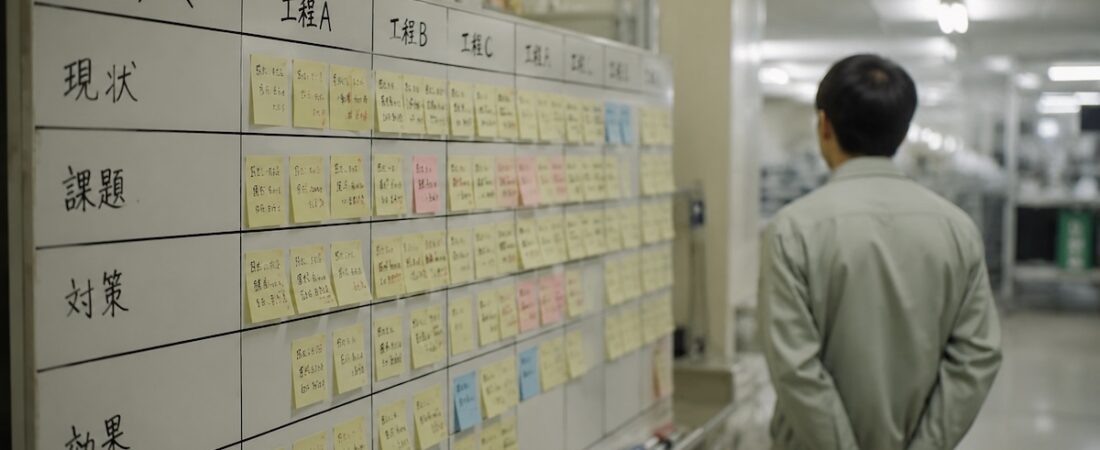
What feels distinctive in Japan — at least to me — is that discipline can continue long after the original purpose has faded. The English student keeps studying. The company keeps optimizing. The improvement activity keeps running. The system keeps functioning.
Perfectly. Efficiently. In entirely the wrong direction.
The Wrong Disneyland
There is a strategist named Tsuyoshi Morioka who once framed this in a way that stayed with me.
If your goal is to go to Tokyo Disneyland, the worst outcome is not staying home. The worst outcome is enthusiastically boarding a plane and flying to Hong Kong Disneyland.
You worked hard. You spent money. You executed perfectly.
You simply went to the wrong place.
What makes this example stick for me is not the mistake. Mistakes happen everywhere. It is the enthusiasm. The execution. The full commitment to the wrong destination.
A Different Reading of Toyota
Most discussions about Toyota begin with the same story: Japanese workers are good at improvement, which is why kaizen worked, which is why Toyota became Toyota. I do not disagree with this. But I wonder if it is the complete picture.
Kaizen is usually translated as continuous improvement. That translation is not wrong. But it can make kaizen sound as if improvement itself is the point. I do not think that is quite right.
Improvement is only meaningful when the direction is right. A process can become smoother. A number can improve. A routine can become more efficient. People can become better at doing the thing they have been told to do. But if the original purpose has already become unclear, improvement can simply make the wrong direction more polished.
That is why the Five Whys interests me.
The Five Whys is closely associated with Toyota: when a problem occurs, ask why repeatedly, often described as asking why five times, until the visible symptom is no longer the only thing you can see. The usual interpretation is that this is a root-cause-analysis tool. Find what went wrong. Fix it. Prevent it from happening again.
That interpretation is not wrong.
But I think there is another way to read it, especially in Japan. What if the Five Whys became powerful not only because Japanese workers are good at execution, but because they are also capable of continuing in the wrong direction with remarkable discipline?
This is the part that matters to me.
In Japan, the problem is often not a lack of effort. It is not that people refuse to do the work. It is often the opposite. People can continue. They can repeat. They can refine. They can protect the process. They can keep going even when the original meaning has become vague.
That ability can create beautiful results. It can also create a dangerous kind of waste.
Not waste caused by laziness.
Waste caused by seriousness.
A method remains. A rule remains. A KPI remains. A test remains. A meeting remains. An improvement activity remains. The purpose quietly fades. And yet the work continues.
This is where I think the Five Whys fits Japan in a deeper way. It is often treated as one tool inside kaizen. Technically, that may be true. But I think that misses something important.
The Five Whys is both a tool and a discipline.
As a tool, it prevents problem-solving from becoming a loose brainstorming session. It is not supposed to mean listing five possible causes for the same problem. Each answer becomes the next problem. The question keeps moving. It does not let the inquiry scatter sideways too easily, and it does not let people stop at the first acceptable explanation.
But as a discipline, it does something even more important.
It keeps pulling execution back toward purpose.
Fishbone diagrams, data analysis, Six Sigma, on-site observation, and other methods can all make the analysis sharper. They increase resolution. They help people see more clearly what is happening. But before those tools can work properly, someone has to keep asking what problem we are actually trying to solve, and why that problem matters.
Without that question, every tool becomes more precise in the wrong direction.
The number five is not sacred. One or two whys may be too shallow. Ten whys in the same line may simply become another forced story. The point is not the number. The point is the discipline of refusing to let action continue without reconnecting it to meaning.
I have no evidence that Toyota designed the Five Whys with this cultural function in mind. I am not claiming they did. I am also not saying the Five Whys is a perfect analytical tool. Complex problems do not always have one clean root cause. If people simply fill in five boxes because the method says so, the Five Whys becomes exactly the kind of ritual it was supposed to prevent.
But that is precisely why I find it interesting.
Used badly, even “why” becomes a form.
Used properly, it is not just a question about cause. It is a discipline that keeps asking whether the work is still pointed at the right purpose.
In that sense, the Five Whys may not be just one small method inside kaizen. It may be the discipline that keeps kaizen from becoming ritual.
“Why” Is Not Only a Question About Cause
The word “why” is usually read as a question about cause. Why did this happen? What produced this result?
But inside a culture already good at execution, “why” can also become a question about direction. Why are we doing this? What were we originally trying to achieve? Is this activity still connected to that purpose?
That is the part I think matters in Japan. Because what I keep noticing is not a lack of discipline. It is discipline continuing after purpose has faded.
This is also why Japan can be so good at maintaining systems, rules, and routines long after the original reason has become difficult to see. I wrote about a related pattern in Why Japan Has So Many Rules — And Why Even Japanese People Struggle With Them: the rule often remains visible long after the purpose behind it has become harder to explain.
Mottainai
I want to name the feeling behind this observation, because I think it is easy to read this as criticism. It is not. The Japanese word mottainai — something like “what a waste” — comes closer.
Japan is often far more capable than it believes. The problem is rarely effort. In most places I have worked, the effort is genuinely there. That is why I keep coming back to the difference between effort and direction, especially in Japanese work culture. I explored that more directly in Why Japanese Work Culture Relies on Effort Over Systems.
What I sometimes feel, watching discipline continue without direction, is not frustration with Japanese people. It is something closer to: you have this. Why are you pointing it there?
That is mottainai.
I Sometimes Wonder
Perhaps that is why a simple question — “Why?” — fit Japan so well. Not because Japanese people are bad at thinking. Because they are extraordinarily good at doing.
And in a society so capable of continuing, someone has to keep asking whether the continuation is still pointing at the right purpose.
This is also why Japanese work can be so hard to explain through job descriptions alone. The work is often not just the task itself, but the surrounding expectations, adjustments, and invisible responsibilities that keep the system moving. I wrote about that in Japan Has No Job Description. That’s the Job.
All of the above is one Japanese person’s interpretation. Treat it accordingly.


Leave a Reply