Why Japan Has So Many Rules — Even Japanese People Struggle With Them
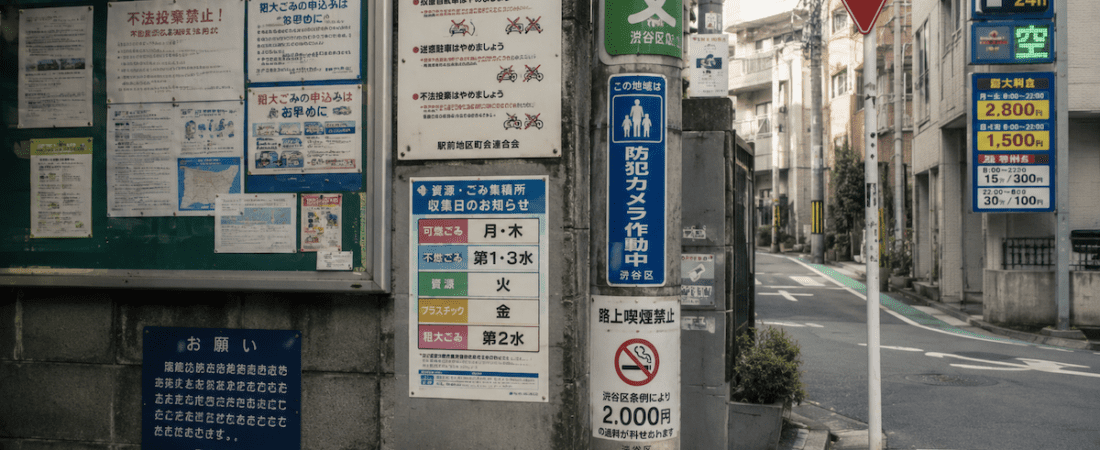
If you’ve spent any time in Japan, you’ve probably noticed it. There are rules for everything. How to sort your garbage. How to walk on an escalator. How to pour someone’s drink before your own. How to hand over a business card. How to bow, and to whom, and for how long.
And just when you think you’ve got the visible ones figured out, you discover there’s an entirely separate layer — unwritten, unspoken, and somehow expected anyway.
Where does this come from?
The short answer
I don’t think Japan has so many rules simply because Japanese people like rules.
Rules do something useful here. They reduce the need for individual judgment. If the rule exists, you follow it. Nobody has to decide from zero. Nobody has to expose themselves by making the wrong call alone.
That matters in a society where being wrong in public can feel heavier than the mistake itself. A rule does not only tell people what to do. It also protects them from having to explain why they chose differently.
There are broader explanations people often point to. Hofstede’s cultural dimensions model, for example, gives Japan a very high score for uncertainty avoidance. Others point to rice farming, which required coordination between neighbors, and to long histories of collective discipline. I would not treat any of these explanations as destiny.
But they do point toward something recognizable: ambiguity is uncomfortable here, and rules are one way of making ambiguity easier to live with.
So the important question is not only why Japan has rules.
It is what those rules are doing for people.
In a society where responsibility without defined limits is genuinely frightening, a rulebook is also a way of not having to decide alone — and not having to be wrong alone.
But even Japanese people struggle
Here’s the part that doesn’t make it into the guidebooks.
The rules aren’t just inconvenient for foreigners. Japanese people carry them too.
The language alone is extraordinary — three writing systems, multiple registers of formality that shift depending on who you’re talking to and what context you’re in. Getting it wrong doesn’t just sound awkward. It signals something about your place in the social order.
Then there’s everything else. The pressure to be 普通 — normal — which is less a description and more a daily instruction. Who you can say what to, and how. When to speak and when to stay silent. The expectation to read rooms, anticipate needs, never impose. The correct phrasing for a work email. The order of set expressions in a formal message. The faint but real sense that using the wrong keigo with the wrong person will be noticed, and remembered.
These things are learned over a lifetime. And even people who grew up here sometimes get them wrong.
The rules didn’t get fewer. They moved.
There’s a version of this story that says Japan is changing. That the younger generation is loosening up. Partly true.
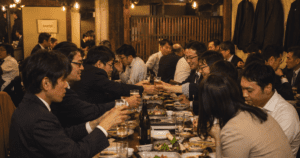
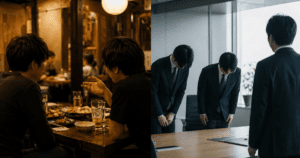
The old salaryman rulebook — attend every drinking party, stay until your boss leaves, never leave before the senior person — has genuinely weakened. Younger workers say no to nomikai. They leave on time.
But the rules didn’t disappear. They migrated.
The pressure that once lived in the drinking party and the overtime hours now lives elsewhere. How quickly you reply to a Slack message. What you say — and don’t say — on social media. The language of gender, parenting, appearance, and mental health, where acceptable vocabulary shifts faster than most people can track. Compliance training. Harassment avoidance. The growing awareness that a single careless post, screenshot and shared, can define how people read you for years.
In Japan, public trust can be unusually hard to rebuild once lost. The nomikai you can decline. The timeline never closes.
For foreigners, there’s an extra layer
Japanese people absorb these rules over twenty years of childhood, school, family, and community. By the time they’re adults, most of it is automatic.
You arrived last year. Or last month. And nobody handed you the manual, because there isn’t one.
The visible rules you can learn. The unwritten ones — how close to stand, how to decline gracefully, what silence means in a given moment — those take years. Sometimes decades.
This is where reading the air becomes less like a skill and more like a lifelong operating system. The rule is not always the rule. Sometimes the real rule is knowing which rule is active in this room, with these people, at this moment.
And here’s something worth knowing: many of Japan’s social rules were designed by and for Japanese people operating within Japanese relationships. They don’t always apply to you in the same way. A foreigner who doesn’t bow perfectly is not committing the same offense as a Japanese person who doesn’t — because the social meaning is different.
So what do you actually need to follow?
Don’t break the law. Be genuinely respectful. Make an effort on the visible things — it signals good faith, and people notice.
The rest? Let it come slowly, through observation, over time. You will get things wrong. So do Japanese people, sometimes.
Give yourself the same grace they’d give a guest.
All of the above is one Japanese person’s interpretation. Treat it accordingly.

Leave a Reply