
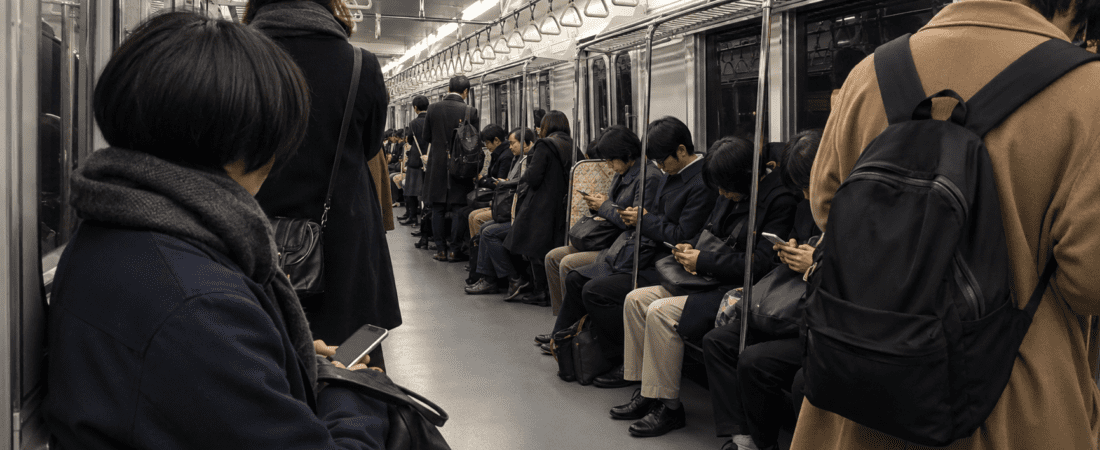
Why Japanese Trains Are Silent: It’s Not Politeness. It’s Territory
First-time visitors to Japan often notice it within minutes of boarding a train.
Nobody is talking. Phones are on silent. Even the occasional cough seems apologetic.
The assumption is usually: Japanese people are just very polite. And that’s true, as far as it goes. But it doesn’t explain the whole thing.
The obvious answer isn’t wrong. It’s just incomplete.
Japanese train silence is partly about manners, but it is also about protecting the small space each person still has in a crowded carriage.
Yes, there are signs on Japanese trains asking passengers to keep their voices down, set phones to silent, and avoid phone calls. The rules exist. People follow them.
This is one small example of a broader pattern in Japan: rules that are never officially posted, but that everyone is somehow expected to know.
But rules don’t explain why the silence feels different here. Why it feels almost physical. Why someone speaking at a normal volume — not loudly, just normally — creates a visible ripple of discomfort through the carriage.
That’s not rule-following. That’s something deeper.
Public space, different definitions
In many countries, public space is understood as open space. A place where people gather, interact, and coexist through noise and movement. Strangers talk to each other on buses. Someone plays music. A group laughs loudly. This is what “public” means — shared, alive, social.
In Japan, public space works differently. Shared space isn’t an invitation to interact. It’s the opposite. The more people there are, the more each individual retreats. The logic is: this space belongs to everyone, so no one should claim it.
The silence on a Japanese train isn’t absence. It’s everyone agreeing, without a word, not to impose.
Sound is different from physical space
Here’s what I find interesting about this.
Personal space — the invisible boundary around your body — is something every culture has. Research suggests it varies by individual and context, but the concept is universal. You don’t stand too close to a stranger. You don’t touch people you don’t know.
But physical distance can be managed. You can move. You can find a corner. You can face a different direction.
Sound doesn’t work that way. Sound travels. It crosses the carriage. It enters your ears whether you want it to or not. A conversation happening three rows away is inside your head.
In that sense, making noise in a crowded space is a form of territorial invasion. Not intentional. Not aggressive. But real.
Japanese people seem acutely aware of this. The silence on the train isn’t just about manners. It’s about not crossing into someone else’s space through sound.
So why isn’t Hong Kong like this?
This is where it gets interesting — because if the “high population density creates sound sensitivity” theory were correct, Hong Kong should be quiet too.
It isn’t. Hong Kong is a useful comparison because it is also dense, urban, and transit-heavy — yet the sound culture feels very different. People talk more openly. Phone sounds are more common.
So density alone doesn’t explain Japan.
My guess — and this is entirely my own — is that it has more to do with how Japanese culture handles conflict and friction. The karaage lemon problem, the tip refusal, the train silence — they’re all versions of the same thing. Don’t impose. Don’t create friction. Don’t make someone else have to deal with you.
Hong Kong has its own social codes, but that particular instinct — the one that says my presence should cost you nothing — seems especially strong in Japan.
It’s also worth noting: this doesn’t apply to groups. A group of Japanese people on a train can be just as loud as anywhere else. The silence is an individual calculation, not a collective rule. The dirty looks from other passengers suggest everyone knows this.
One more thing
Japanese commutes are long — in major urban areas, an hour each way is normal. For many people, that time on the train is the only genuinely private time in their day — surrounded by people, but belonging to no one, accountable to no one.
The silence protects that. For everyone.
All of the above is one Japanese person’s interpretation. Treat it accordingly.



Leave a Reply