
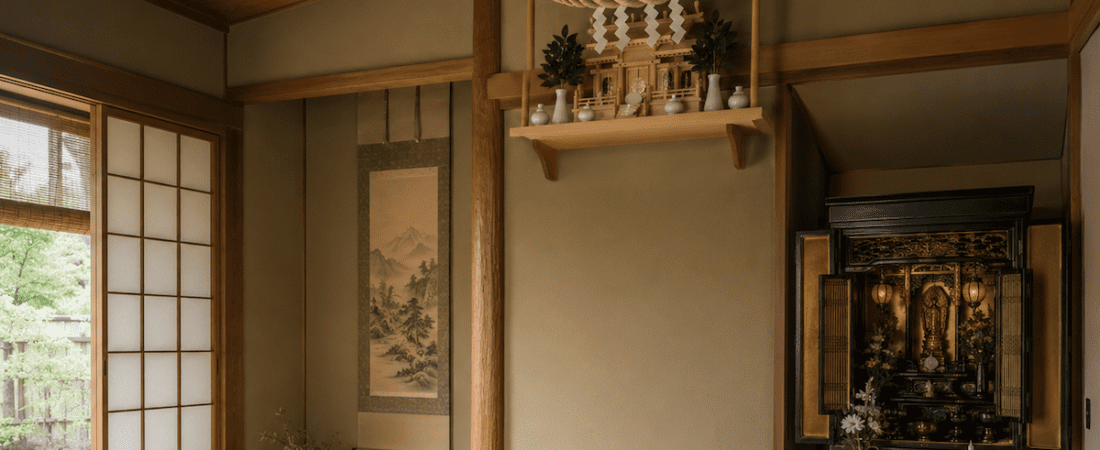
A Shinto Shrine and a Buddhist Altar in the Same Living Room. Nobody Was Confused.
My father was Buddhist, loosely. The kind where you show up for funerals and let the rest slide. My mother was Protestant.
We didn’t have a household shrine or a family altar. Growing up, I observed both from a slight distance — close enough to understand, far enough to notice.
Which might be why I find the Japanese approach to religion one of the most quietly remarkable things about this country.
Two religions. One house. No contradiction.
In many Japanese homes — fewer now than a generation ago, but still common — you’ll find both a kamidana (Shinto household shrine) and a butsudan (Buddhist altar) in the same room.
To someone from a stricter monotheistic tradition, this looks strange. You believe in one God, or you don’t. You’re Christian, or you’re Muslim, or you’re Jewish. The categories are meant to be exclusive.
In Japan, they aren’t.
A family might pray at the Shinto shrine in the morning, attend a Buddhist funeral in the afternoon, and celebrate Christmas in December. Not as an act of contradiction. Not despite their beliefs. Just… as life.
But they don’t face each other.
There are rules about how the kamidana and butsudan can coexist. They can share a room. Traditionally, they should not face each other directly.
The reason given is practical: if you bow to one, you put your back to the other. That’s considered disrespectful.
But I think the deeper logic is something else.
Facing them toward each other would force a confrontation — which one is right? Which takes precedence? The Japanese solution is to angle them away from each other, so the question never has to be answered. Both exist. Both are honored. Neither demands that the other be wrong.
This is not indecision. It’s a different relationship with truth entirely.
The word for it is shinbutsu-shūgō.
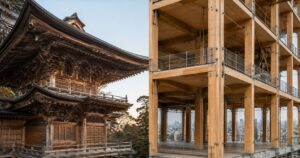
It means, roughly, the fusion of gods and buddhas. For most of Japanese history — until the government forcibly separated Shinto and Buddhism in 1868 — the two traditions were intertwined so deeply that separating them felt unnatural. Temples had shrines inside them. Shrines had Buddhist monks performing rituals. The gods and the buddhas were neighbors, not rivals.
The forced separation didn’t fully take. Walk through Japan today and you’ll still find the two traditions living next to each other, quietly, without requiring resolution.
This shows up everywhere, once you start looking.
The same person who wears a crucifix for fashion might carry an omamori (Shinto charm) in their bag and burn incense at a Buddhist grave. Not cynically. Not carelessly. Just holding multiple things at once, without needing them to add up to a single coherent system.
Japan often allows “I don’t know” and “both” and “it depends” to sit longer than cultures that prefer a definitive answer.
The nail that sticks up gets hammered down — that’s the famous proverb about conformity. But there’s a quieter counterpart that doesn’t get quoted as often: the Japanese capacity to hold contradictions without resolving them.
The fashion that’s both individual and uniform. The apology that’s also a thank you. The public silence that coexists with private noise. The house with two altars, angled away from each other, each minding its own direction.
My parents never resolved their differences either.
They just faced different directions.
It worked.
All of the above is one Japanese person’s interpretation. Treat it accordingly.

Leave a Reply