
Why a Resume Gap Is a Red Flag in Japan: The Unbroken Line
In much of the Western world, attitudes toward resume gaps have shifted significantly. A career break for travel, caregiving, burnout, study, recovery, or simply figuring out what comes next is increasingly accepted — something to explain briefly, not apologize for.
In Japan, particularly in traditional companies, the gap itself remains the problem. Not always. Not everywhere. But the tendency is real, and it is worth understanding why.
What the gap signals.
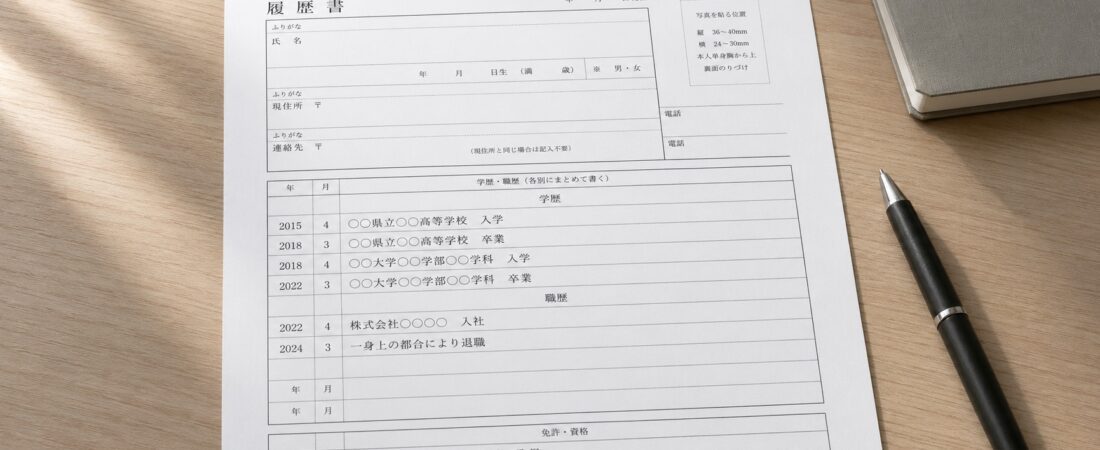
Japanese hiring, particularly in traditional companies, operates on a model that values continuity above almost everything else. The ideal candidate entered the workforce at the right time — April, straight out of university — and has been employed, without interruption, ever since.
A gap does not just raise questions. It raises a specific kind of suspicion: that something went wrong. That you could not hold a position. That you made an unusual choice, which is to say, a choice that puts you outside the expected track.
This is not about the gap’s content. It is about the gap’s existence. The assumption is not, “Let’s find out what happened.” It is, “Why did the line break?”
Where this comes from.
To understand this, you have to understand how Japan treats continuity.
There is a phrase Japanese children hear in school, in sports clubs, and in conversations about work: keizoku wa chikara nari. Continuity is power. The idea is that sustained effort — regardless of immediate results — builds something real.
And sometimes it does.
There is real value in showing up. There is real value in staying with something long enough to become good at it. There is real value in not quitting the moment something becomes boring, difficult, or invisible.
Japan understands this very well. Maybe too well.
In that framework, a gap is not neutral. It looks like interrupted commitment. And interrupted commitment, in a culture that reads continuity as character, can start to look like a character flaw.
I learned this from a window.
When I was in my early twenties, working at a manufacturing company, I had an experience that taught me more about this than any HR policy ever could.
Our department went through a 5S audit — a workplace cleanliness inspection. I managed the prototype room alone, and the timing was bad. Development work had piled up, things were disorganized, and I scored around 30 out of 100.
I was annoyed. Not because the score was unfair — it was not, given the state of the room at that moment. But because the same people who gave me that score walked past a factory floor that had not been properly cleaned in years. There were windows in that factory that I was fairly certain no one had ever wiped.
So I decided to wipe them. Not because anyone asked me to. Not during work hours — I did it in the ten minutes before my shift started, so no one could object. Just me and a cloth, every morning, working through windows that had accumulated years of industrial grime.
About a month in, something shifted. People who had barely acknowledged me before started stopping to talk. My opinions, which had previously been easy to dismiss — I was young, I was on a dispatch contract, I did not have the credentials that commanded attention — started being heard.
Not because my ideas had changed. Because I had demonstrated something over time.
I had not produced a dramatic result. I had not made the company more profitable. I had not solved a strategic problem. I had shown up, consistently, and done something nobody asked me to do.
In Japan, that combination carries a specific kind of weight.
The signal is real. The mistake is confusing it with competence.
The window cleaning changed how people saw me. I believe that. But I also know that the windows being clean was not, in any meaningful business sense, what mattered.
What mattered was the signal — that I was someone who committed to something and followed through, day after day, without being watched.
That signal is real. It can reveal discipline, patience, humility, and care. It can show that a person is not only performing when someone important is looking.
The problem begins when that signal is mistaken for actual competence.
The same logic that rewarded me for wiping windows is the logic that treats an unbroken resume as evidence of reliability. It does not ask first what the person can do. It asks whether the line stayed intact.
Because an unbroken line can mean commitment. It can also mean fear. It can mean endurance. It can also mean that a person simply never had to make a difficult choice outside the expected path.
But on a Japanese resume, the line itself carries meaning before the explanation begins.
What this costs.
The resume gap problem is one symptom. The person who took a year off to travel, care for a parent, recover from burnout, study abroad, leave a bad environment, or simply rethink their life finds themselves explaining not just what they did — but why they broke the line.
The explanation is almost beside the point. The line broke. That is what registers.
In an interview, even a perfectly reasonable gap often has to be explained with a faintly apologetic tone. Not because the reason is shameful, but because the candidate is expected to show that they understand the gap needs explaining.
That is the strange part. The person is not only explaining a period of time. They are quietly performing awareness of the fact that the continuity was interrupted. They have to show that they know this was not normal, that they are not careless, that they are still safe to bring back into the grid.
The deeper cost is harder to see. When continuity becomes the primary signal of trustworthiness, the people who stay accumulate trust by default. The people who leave — even for good reasons, even briefly — carry a mark they may not have earned.
This shapes how people think about their own lives. A person may know they need a break, but fear the gap. A person may want to leave a bad company, but fear the explanation. A person may want to study, recover, care for family, or change direction, but worry that the blank space will speak louder than the reason behind it.
So they stay. Not because staying is always good. Because leaving creates a mark.
Japan is changing. Slowly.
Younger generations are more willing to move, to take breaks, to build careers that do not follow a single straight line. Some companies now look more seriously at skills, projects, and actual experience. Some hiring managers understand that a gap can mean maturity, risk-taking, recovery, international exposure, or simply a person refusing to stay somewhere they should have left.
That matters.
But the older logic is still in the room when resumes are reviewed. Keizoku wa chikara nari. Continuity is power. The phrase is still familiar. The instinct is still there. The line still matters, even when nobody says it out loud.
The unbroken line.
The problem is not that Japan values commitment. Commitment is worth valuing.
The problem begins when an unbroken line is mistaken for proof of character.
A resume gap does not always mean irresponsibility. An unbroken career does not always mean strength. A straight line is not the same thing as a meaningful one.
But in Japan, the straight line still has power. It reassures people. It explains you before you speak. It tells the reviewer that you stayed inside the expected rhythm of society.
And if your line broke, for whatever reason, you may find yourself explaining not only what happened.
But why you allowed the line to break.
All of the above is one Japanese person’s interpretation. Treat it accordingly.



Leave a Reply