
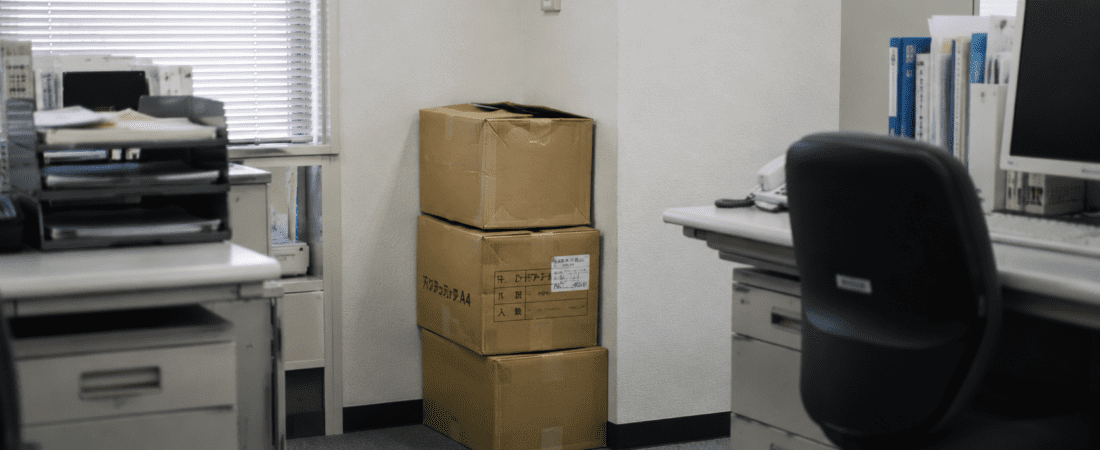
Why Is There Always a Cardboard Box in the Corner of a Japanese Office?
Every foreign manager I’ve worked with has noticed it.
They walk into a Japanese office for the first time — sometimes flying in from Europe or the United States, sometimes just moving between floors — and somewhere in the room, there it is. A cardboard box. Maybe two. Sometimes a stack. Sitting in the corner, or against the wall, or tucked under a desk where it has apparently been sitting for some time.
And they ask, with varying degrees of diplomacy: why is that there?
It’s a small thing. But the answer turns out to be more interesting than the question.
The Gap Between Japan’s Reputation and Japan’s Offices.
Japan has a global reputation for orderliness. And in certain contexts, that reputation is entirely earned.
Japanese manufacturing — especially through the influence of the Toyota Production System — gave the world 5S: sort, set in order, shine, standardize, sustain. On Toyota’s manufacturing floors, and on factory floors worldwide that adopted its methods, 5S produced something genuinely impressive: workspaces where everything had a place, waste was visible, and disorder was treated as a problem to be solved immediately.
But here’s what often gets missed: 5S was born from the logic of production environments. Its origins are in manufacturing, not in office environments. It can be applied to offices, but it does not automatically arrive there with the same force. And the discipline that keeps a production line immaculate does not automatically transfer to the room where the accountants sit.
The foreign manager arriving with expectations shaped by Toyota’s reputation is, in a sense, walking into the wrong room. The orderliness they expected is a few floors below, on the factory floor. Up here, there’s a cardboard box in the corner.
What Cardboard Means in Japan.
In many Western office cultures, a cardboard box is a transitional object. It arrived containing something. The something was removed. The box will be broken down and recycled, or thrown out. Its continued presence would be mildly embarrassing — evidence that someone hasn’t finished dealing with it.
In Japan, the relationship with cardboard is different.
Cardboard boxes don’t arrive and get discarded. They accumulate. From Amazon deliveries, from suppliers, from the last time someone moved desks. Open one and you might find it sealed with packing tape, containing a stack of printed documents from a project that ended years ago, or a tangle of cables left by someone who no longer works here — items that nobody has officially declared finished with, preserved like a small time capsule in the corner of a shared space. A clean, intact box is not waste. It’s a resource. It might be useful for storing documents. It might be needed for the next time something needs to be shipped.
Throwing it away feels wasteful. Mottainai — the Japanese concept of reluctance to waste something that still has value — applies here in a quiet but persistent way.
And buying a cardboard box, when perfectly good ones are available for free, would itself feel slightly absurd. So the boxes stay. Not because no one noticed them. Because throwing them away would feel like throwing away something useful.
The Mottainai Paradox.
Here is where it gets interesting.
Japan has a genuine and deep anti-waste instinct. The concept of mottainai — broadly, the sense that discarding something with remaining value is wasteful and wrong — predates any modern sustainability movement. It is embedded in how Japanese people relate to objects.
And yet this same instinct, applied to cardboard boxes, produces an office that a visiting European executive finds chaotic.
The box is not clutter, from the Japanese perspective. It is a resource that hasn’t found its next use yet. The intention is not to be messy. The intention is, in a certain sense, to be responsible.
The foreign manager sees disorder. The Japanese colleague sees an unused asset.
Why Nobody Moves It.
Here’s the part that’s easy to misread.
It would be tempting to say: nobody moves the box because nobody knows whose job it is. And there’s something to that — Japanese workplaces often lack explicit role definitions, which means not only that nobody has been assigned responsibility for the box, but that anyone who moves it unilaterally risks being seen as having overstepped.
But that’s not quite the whole story.
In many cases, there are people in the office who notice the box, who would prefer it wasn’t there, who might even have considered moving it. The issue isn’t indifference. It’s hesitation.
Moving the box means making a decision about someone else’s space. It means potentially throwing away something that a colleague was keeping for a reason. It means taking a visible action on shared territory without being asked.
In a Western office, removing the box might read as initiative. In a Japanese office, it might read as overstepping.
“What if someone still needs it?” is a real concern, not an excuse. Throwing away the wrong thing — or rearranging something that turns out to have been placed intentionally — invites a particular kind of quiet social cost that is difficult to explain to someone who hasn’t experienced it.
So the box stays. Not because no one cares. Because caring, in this context, requires a kind of initiative that the environment makes surprisingly difficult to exercise.
What the Visiting Manager Is Actually Seeing.
When a foreign executive walks in and immediately identifies the cardboard box as a problem, a few things are happening simultaneously.
They are applying an aesthetic standard shaped by Western office culture, where visible clutter signals disorganization and disrespect for the workspace.
They are applying a practical standard where unused packaging is waste by definition.
And they are operating from a baseline assumption that if something is wrong with a shared space, the right response is to fix it — and that doing so requires no special permission or consideration.
All of those assumptions are reasonable. None of them are universal.
The Japanese colleague who has walked past that box every day for three weeks isn’t failing to see it. They’re seeing it differently — as a thing that belongs to someone, that might still be useful, that isn’t theirs to move without a reason.
A Small Thing That Isn’t Small.
The cardboard box won’t make it into any management textbook. It’s too mundane. But I’ve found it to be one of the more reliable indicators of the distance between how Japan’s workplaces are imagined from the outside and how they actually function on the inside.
The tidiness of a Toyota factory is real. The mottainai instinct is real. The social friction around unilateral action in shared spaces is real. And the gap between what foreign visitors expect and what they find is also real — and more interesting than it first appears.
All of the above is one Japanese person’s interpretation. Treat it accordingly.



Leave a Reply