
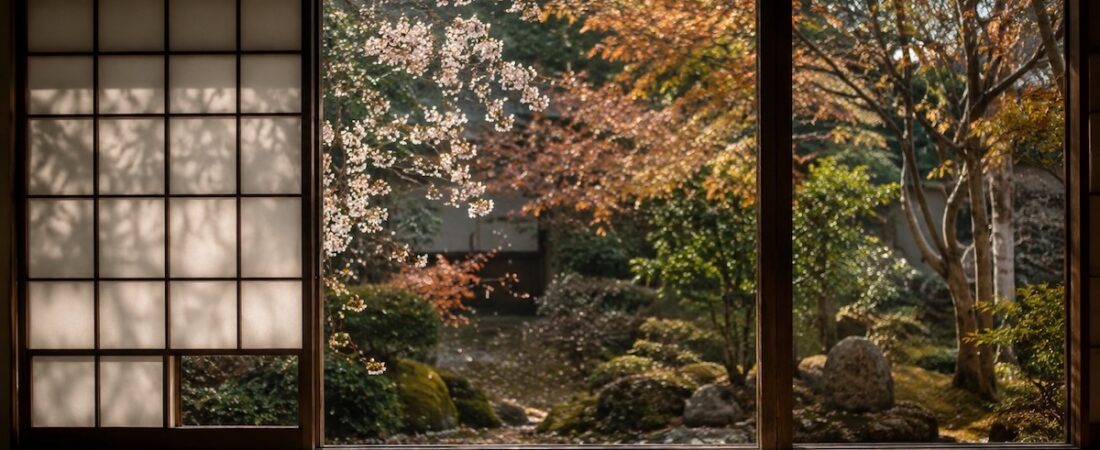
Japan Has Four Seasons. Have You Heard?
A Japanese friend once asked me, with genuine curiosity, whether other countries really have four seasons.
She had heard, somewhere along the way, that they did not — not the way Japan does, anyway. She had never traveled abroad. She had never had a particular reason to question what she had heard. The idea had simply been passed down to her: that the four seasons — and the way Japanese people feel about them — were something Japan had that other places did not.
I did not laugh. But I have been thinking about that conversation ever since.
The Conversion
Japan has a strong relationship with its seasons. That part is true.
The cherry blossoms in spring, the heat and cicadas of summer, the foliage in autumn, the quiet cold of winter — these are not just weather. They are woven into food, into poetry, into the way people talk about time. The seasonal awareness is real, and it runs deep.
But somewhere in the telling, something shifts.
“In Japan, the seasons are felt deeply in daily life” becomes “Japan has four seasons.”
And then, with one more step that nobody quite notices: “Other countries don’t have them the same way” slides quietly toward “other countries don’t really have them.”
This is the conversion I keep noticing. A genuine difference in how something is expressed quietly becomes a claim that Japan alone has the thing.
It is not only the four seasons.
“In Japan, people tend not to say no directly” becomes “Japanese people don’t say no.”
“In Japan, being considerate often means not imposing” becomes “Japanese people are considerate.”
“In Japan, reading unspoken signals is important” becomes “Japanese people read the air.”
And then, one step further: “Other people are more direct.” “Other cultures are less considerate.” “Foreigners don’t read the room.”
The Words Are Already There
English has phrases for this. Several of them.
Read the room. Read between the lines. Pick up on cues. Take the hint. Know when to stop.
These are not exotic imports. They are ordinary English expressions, used by ordinary English speakers, in ordinary situations. The ability to read unspoken meaning is not a Japanese invention. It is a human one.
The difference is not that Japanese people notice atmosphere and others do not. The difference is what each culture has decided counts as reading the room — what signals matter, what the correct response looks like, what it means to be considerate.
In Japan, consideration often means not making your needs visible. Not burdening the other person with a clear refusal. Leaving space for the other person to interpret.
In other contexts, consideration can mean the opposite. Being clear so the other person does not have to guess. Not letting someone hope for something you cannot give. Respecting someone’s time by not making them decode you.
Both are consideration. The definition of consideration is what differs.
People I Know
I have a Swiss former colleague, now one of my closest friends, who I would describe as more careful about others than many Japanese people I know. He is direct when he needs to be. But he is never thoughtless. He notices things. He holds back when holding back is the right move. He reads the situation.
I also worked alongside an American colleague who watched faces before he spoke and read the room before he opened his mouth — the very thing people insist only Japanese people do. He was one of my closest friends at the time.
I have an Indian friend, a former colleague, who was unfailingly considerate throughout the years we worked together. Not because I was his manager and he was being strategic. Because that is simply who he is.
I am not making a statistical argument. I am not saying these people represent their countries.
I am saying: the claim that “Japanese people are considerate and foreigners are direct” is too simple to be useful. I have met too many people on the wrong side of that claim for me to take it seriously.
What Is Actually Different
Japan is different. That part I believe.
The forms are different. The situations in which directness is chosen versus avoided are different. The social cost of saying no out loud is different. The weight placed on not disrupting the atmosphere is different.
These are real. They are worth explaining. They are worth understanding.
But they are differences in form, not in presence.
The interesting question is not whether Japanese people care about others. Of course they do. The interesting question is: what shape does caring take here, and why?
Why does consideration in Japan so often mean staying unclear? What makes explicitness feel inconsiderate in certain contexts? When did “not burdening someone with a clear answer” become the definition of kindness — and is that definition still working?
Those are worth asking. “Japanese people are considerate, foreigners are not” is not.
Why It Matters
There is a version of Japan that gets smaller every time someone explains it with broad strokes.
Japanese people read the air. Foreigners do not. Japanese people are indirect. Foreigners are direct. Japan has four seasons. Other countries do not, really.
This version of Japan is easier to explain. It is also less true.
The interesting thing about Japan is not that it has things other cultures do not.
The interesting thing is how often familiar human behaviors take unfamiliar forms here. Forms that were once efficient, and are now sometimes outdated. Forms that were once shared, and are now sometimes not.
That is a more honest and more interesting story.
Japan is different. Just not always in the way Japanese people explain it.
All of the above is one Japanese person’s interpretation. Treat it accordingly.



Leave a Reply