
Why Japanese Food Tastes Quiet. And Why That’s the Point.
Foreign colleagues and friends have said it to me more than once, in different ways. The food is good, but it’s a bit… quiet, isn’t it? Or: I expected more flavour. Or simply: I’m not sure I get it.
I always found this interesting. Not because they were wrong — they weren’t, exactly — but because the thing they were noticing is actually the whole point.
Rice Is the Star.
Of course, not all Japanese food is mild. Ramen, curry, sukiyaki, and plenty of regional dishes can be intense. But the core logic of the traditional Japanese meal is different.
In a Western meal, the protein is the centerpiece. The steak, the grilled fish, the roast — everything else exists to support it. The sauce complements the meat. The vegetables are on the side. The whole plate is built around one dominant flavour.
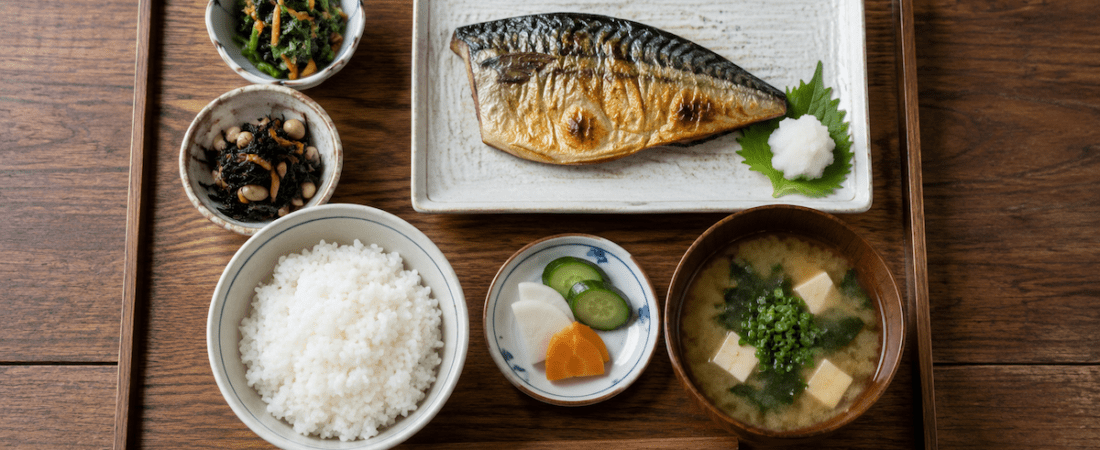
In a Japanese meal, rice is the centerpiece. Everything else — the fish, the vegetables, the pickles, the soup — exists to accompany the rice. There’s even a word for it: okazu. Usually translated as “side dish,” but the literal function is closer to “the thing that makes rice worth eating.” Not dishes. Not courses. Things that go with rice.
This changes everything about how flavours are calibrated.
If your food is designed to be eaten with plain rice, it can’t be too strong on its own. Something intensely seasoned would overwhelm the rice. So the flavours are tuned to work in combination — a bite of fish, a bite of rice, a sip of miso soup, back to the fish.
And there’s something else happening in that sequence that’s easy to miss. The chef doesn’t finish the flavour on the plate. They bring it to about seventy percent. The rest gets completed in the mouth — okazu meeting rice, textures and tastes combining in the moment of eating. The rice is a blank canvas. The okazu gives it meaning. Together, they make something neither could make alone. Japanese cooking has a phrase for this: kouchuu choumi — seasoning inside the mouth.
Eat the fish alone and it might seem understated. Eat it the way it’s meant to be eaten and it clicks.
The Tongue Never Gets Stuck.
I remember eating Thai food at a restaurant in the United States. Big plate, bold flavours, generous portion. It was good. Halfway through, I realised I’d stopped tasting it. The flavour had settled in and stopped registering.
That meal happened to be Thai, but the issue wasn’t Thai food. It was the format.
A Japanese meal keeps moving. Multiple small dishes, eaten in rotation. A bite of simmered vegetable after the grilled fish. A bite of pickle whenever the palate needs resetting. No fixed order — just available. Each element nudges the palate in a slightly different direction. Nothing has time to go flat.
The mild flavours aren’t a limitation. They’re what makes the rotation work. Strong flavours would compete with each other. Mild flavours make room for each other.
The Pickle Is Always There.
Most cultures have something that resets the palate. France has sorbet between courses. India has raita. Wine tastings have plain crackers.
What’s different in Japan is that the reset is always available. Not between courses — there aren’t really courses in the Western sense. The pickles sit on the table throughout the meal, there whenever you need them. A piece of tsukemono between the fish and the rice. Not a ceremony. A permanent reset station, always within reach.
Sushi Says It All.
Gari — the pale pink pickled ginger served alongside sushi — is sweet and sour for a reason. Just enough acid to clear the previous fish from your palate before the next piece arrives. Not sharp enough to overpower, not mild enough to be useless. Tuned precisely for the job.
Ginger was also understood to have antibacterial qualities, which mattered more in a world before modern refrigeration. Over time, it got refined into something more precise: a tool for keeping the palate open, so the twelfth piece tastes as distinct as the first.
Agari — the green tea served at sushi restaurants — does the same thing in liquid form. The slight bitterness dissolves the fat from oily fish, preparing the tongue for something lighter.
The whole philosophy of Japanese food, in one small pink pile of ginger.
So When It Seems Too Subtle.
It probably is — eaten alone.
A single piece of simmered fish, in isolation, might not impress. But that’s not how it’s meant to work. It’s one note in a sequence. The rice is there. The soup is there. The pickles are there. Eaten together, in rotation, the whole thing lands differently.
Japanese food isn’t mild because Japanese chefs lack ambition. It’s mild because the ambition is in the system, not the individual dish.
All of the above is one Japanese person’s interpretation. Treat it accordingly.



Leave a Reply