
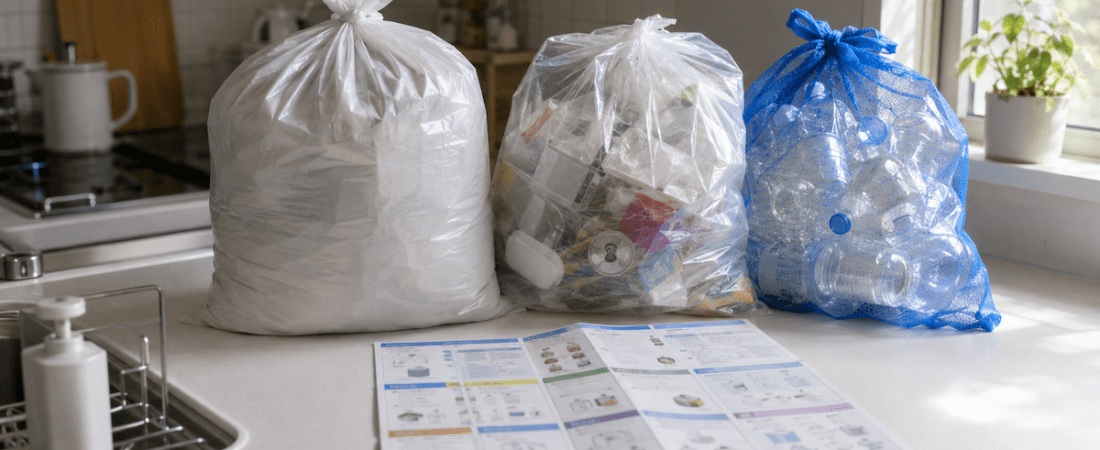
1,700 Cities. 1,700 Garbage Rules. Welcome to Japan.
One of the first things foreigners figure out when they move to Japan is that throwing away trash is complicated.
There are guides. There are designated days. There are categories. There are bags. And there are neighbors who will absolutely notice if you get it wrong.
Most articles will tell you the basics: burnable garbage, non-burnable garbage, recyclables. Separate them. Put them out on the right day. Done.
That’s not wrong. But it’s also maybe a quarter of the actual story.
There Is No Single National Garbage Rule
Here’s the thing that most explainers skip: Japan does not have a unified national garbage system.
The rules are set by each municipality — and Japan has over 1,700 of them. Every city, town, and ward decides its own categories, its own collection days, its own bag requirements, its own definitions of what counts as what. The national government provides guidelines and legal frameworks, but enforcement and day-to-day implementation are largely local.
What this means in practice is that moving to a new neighborhood in Japan — even within the same prefecture — means learning a completely new set of rules from scratch. Not as a foreigner. As a Japanese person, too.
I’ve lived this. In the city where I live in Kanagawa Prefecture, you have to buy designated garbage bags — specific ones, sold at convenience stores and supermarkets — and put them out in front of your house on the correct day. The price of those bags isn’t arbitrary: in many places, it’s a built-in waste disposal fee, a quiet tax on what you throw away. In another city in the same prefecture, where I work, you use any semi-transparent bag and bring it to a communal collection point. No designated bag. No door collection.
Same prefecture. Completely different system. Neither one is more “correct” than the other.
The Bag You Have to Buy
In municipalities that require designated bags, you cannot use a random plastic bag from the supermarket. You have to purchase the official bags — in various sizes, for various categories — at a local store.
In many places, the revenue from those bags partially funds the garbage collection system. It’s a form of taxation on waste, built into the consumer experience so quietly that most residents don’t think of it that way. You’re paying to throw things away every time you buy a bag, and for most of your life in Japan, you’ll never notice.
Foreigners notice.
“Burnable” Depends on What Your Town Can Burn
Here’s where it gets genuinely interesting.
Whether plastic counts as burnable garbage — or non-burnable, or recyclable — depends partly on the incineration capacity and recycling infrastructure of your local facility.
Municipalities with high-temperature incinerators can burn plastic safely and efficiently. So plastic goes in the burnable bin. Municipalities without that infrastructure can’t, so plastic is sorted separately: either as non-burnable waste or as a resource to be recycled.
The same yogurt container. Different bins. Different cities.
This isn’t arbitrary. It’s engineering. The garbage rules in your neighborhood are downstream of decisions made about infrastructure decades ago — what kind of incinerator to build, how much to invest, how much land was available for disposal. The citizens follow whatever those decisions produced.
That’s worth sitting with. The complexity foreigners experience isn’t a cultural choice. It’s an infrastructure inheritance.
And the system has human enforcers too — not inspectors from city hall, but neighbors. In many areas, a neighborhood association manages the local collection point and rotates the duty of overseeing it. The communal gaze is part of the infrastructure.
You Washed That Plastic. Here’s What Probably Happened to It.
Most conscientious residents of Japan — Japanese and foreign alike — rinse their plastic containers before putting them in the recycling bin. It’s on the guide. It feels responsible.
It might also be largely pointless.
A large share of Japan’s plastic waste is thermally recovered rather than materially recycled — burned for energy through a process called thermal recycling. Depending on the dataset, thermal recovery accounts for well over half of Japan’s plastic “recycling.” It’s not nothing, but it’s also not what most people picture when they think “recycling.” In much of Europe, thermal recovery isn’t even classified as recycling. In Japan, it counts.
Some plastic does get materially recycled. The sorting is not fake. But the path from your kitchen sink to actual recycled material is less straightforward than the pamphlet makes it feel.
Maybe that’s the point. The act of sorting isn’t just logistics. It might also be — at some level — about participation. About being the kind of person who follows the rules, even when the outcome is less certain than the rules imply.
Or maybe I’m reading too much into it.
The Complexity Isn’t Personality. It’s Geography.
Japan is a mountainous island nation with limited flat land, high population density, and no room for the kind of sprawling landfills that other countries rely on. The pressure to minimize what goes into the ground — and to maximize what can be burned, recycled, or repurposed — is real and structural.
The 45-category system used by Kamikatsu, a small town of 1,500 people in Tokushima Prefecture, is the extreme version of this logic. It’s famous internationally. It’s also not representative of most of Japan. But it shows where the pressure points are.
When space is genuinely scarce, you sort more carefully. When every municipality is solving this problem independently, you get 1,700 different answers.
None of them are wrong. They just aren’t the same.
What This Feels Like From the Inside
Moving within Japan and confronting a new garbage guide for the first time is a small, specific kind of humbling.
You thought you knew how to throw things away. You’ve been doing it your whole life. And then you’re standing in your new kitchen holding a plastic tray, reading a four-page fold-out pamphlet, trying to figure out whether this counts as “plastic packaging” or just “plastic.”
Japanese people go through this too. That part doesn’t get mentioned often enough in the guides written for foreigners — the ones that imply there’s a system to learn, a correct answer, a destination. There is. It just varies by zip code.
All of the above is one Japanese person’s interpretation. Treat it accordingly.
Leave a Reply