
The Lemon on the Karaage: It’s Not Harmony. It’s Just Easier.
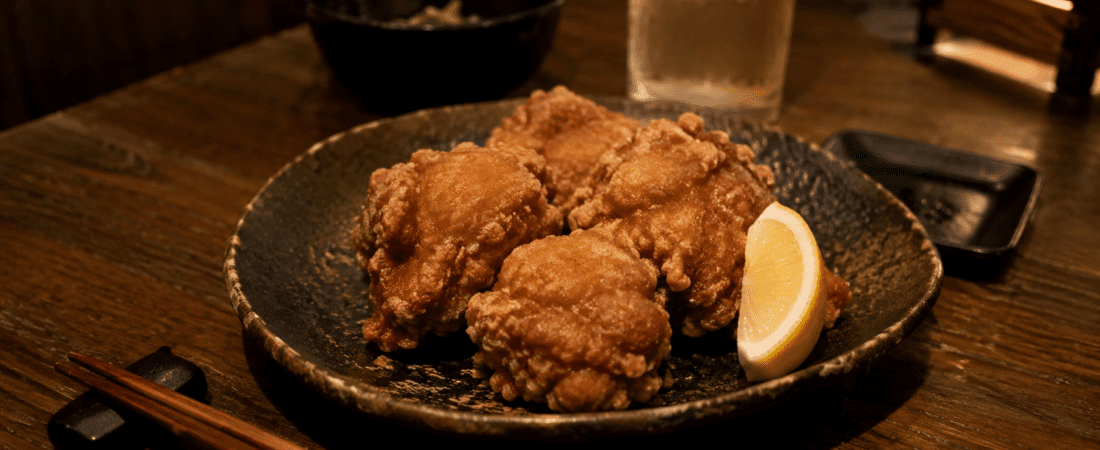
You’re at an izakaya. The karaage arrives — golden, crispy, still steaming. Someone reaches for the lemon wedge on the side.
The table goes quiet.
Not dramatically. Just… slightly.
First, some context.
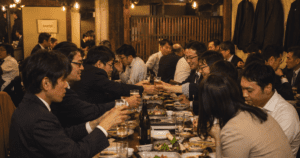
Sharing food is the default setting at a Japanese table. You don’t order your own plate and guard it. You order several dishes for the group, and everyone takes from the middle. It’s not a special occasion thing. It’s just how eating works.
To make this function, there’s usually a pair of communal chopsticks — saibashi — sitting on the table. You use those to take food from the shared plate, not your own chopsticks. If there are no saibashi, the polite move is to flip your chopsticks around and use the clean end.
Though “clean” is debatable. You’ve been gripping that end for the last twenty minutes.
Nobody says anything about this. It’s one of those contradictions that lives quietly in the middle of the table, unexamined.
Then there’s the lemon.
The lemon problem.
With karaage, a lemon wedge often comes on the side. The question of whether to squeeze it over the shared plate is, technically, a matter of personal preference.
Some people want it. Some people don’t.
Here’s the thing: I genuinely don’t care either way. Lemon, no lemon — the karaage tastes fine. What I do care about is the conversation that might follow if someone squeezes it without asking. Because that conversation, in Japan, has a way of not going well.
It won’t be a debate. It will be an atmosphere. A slight shift in energy. Someone who wanted the lemon unsqueezed will not say so directly — but you’ll feel it. And now the table is doing invisible work to smooth things over, and everyone is performing enjoyment a little harder than before.
This is the actual cost of the lemon.
Japanese consideration isn’t only about kindness.
There’s a version of this story that gets told about Japan — that the people here are uniquely thoughtful, considerate, attuned to others. And there’s truth in it. But I think the mechanism is different from what it looks like from the outside.
A lot of what looks like consideration is actually conflict avoidance. The math isn’t “what does the other person want?” It’s “what’s the least likely to cause friction?”
Ask before squeezing the lemon. Use the communal chopsticks. Offer the last piece to someone else before taking it yourself. These aren’t expressions of warmth. They’re the operating costs of sharing a table without incident.
The goal isn’t harmony. The goal is the absence of disharmony. Those sound similar. They’re not.
Why disagreement feels personal.
Japan is often described as a culture that doesn’t debate well. That’s accurate, but the reason matters.
It’s not that Japanese people lack opinions. It’s that there’s no shared framework for having a disagreement without it feeling like an attack. In cultures where debate is normal, you learn early that “I disagree with your position” and “I have a problem with you” are different things. In Japan, that distinction is blurry. Conflict and aggression live close together.
So the rational move — and most people make it instinctively — is to never let conflict surface in the first place. Absorb the inconvenience. Say nothing. Reach for the lemon only after a quick scan of the table tells you it’s safe.
This is not weakness. It’s a highly developed social calculation, running constantly, in the background, at every meal.
The table is harmonious. Or something that looks exactly like it.
And sometimes, of course, it really is kindness. The tricky part is that in Japan, kindness and friction avoidance often wear the same clothes.
All of the above is one Japanese person’s interpretation. Treat it accordingly.


Leave a Reply