
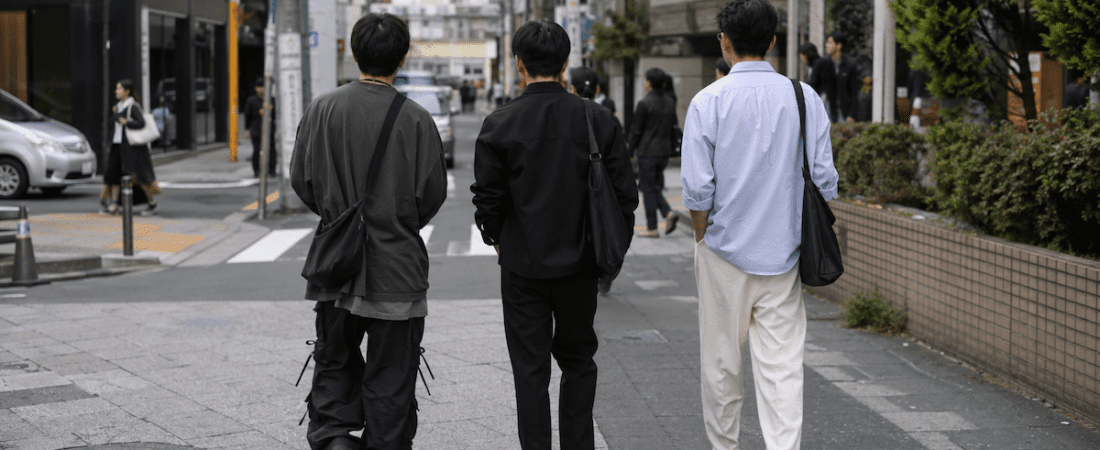
Can Japanese People Tell Japanese, Koreans, and Chinese Apart? Honestly, Less and Less.
Someone asked me once if I can tell Japanese, Korean, and Chinese people apart. I paused. Laughed a little. Then said something like: “Sometimes. Kind of. Not really anymore.”
That’s the honest answer.
There’s No Reliable Method. There Never Really Was.
Nationality is not written cleanly on a face. East Asian populations have long histories of migration, overlap, and movement across borders — and the idea that you could read someone’s national origin from their features was always shakier than it felt.
The lines were already blurred long before K-pop existed. Centuries of movement and contact between neighboring countries made them so.
What we were reading, when we thought we could tell, was never really race. It was styling, class, media exposure, and the historical moment someone happened to be standing in.
The 1990s Were Probably the Peak of Visible Difference.
Japan’s fashion scene was detonating. Ura-Harajuku, Shibuya-kei, kogal culture, the used-clothing boom — all of it happening simultaneously, all of it distinctly Japanese. Hair bleaching was already normalized. Walking through Shibuya in 1997, you’d see colors and silhouettes that existed nowhere else on earth.
Korea’s modern fashion industry was still developing in the 1990s. What emerged was hip-hop influence — Seo Taiji and Boys arriving in 1992 and reshaping what Korean youth culture could look like — high-end brand consumption among wealthy youth, and the early stirrings of what would eventually become K-style. Hair dyeing was still seen as delinquent behavior. The older generation didn’t approve.
Urban China, at least in the image many Japanese people had in the 1990s, seemed to be in a different fashion moment entirely. Collared shirts. Polo necks. Tucked in. The casualwear revolution hadn’t arrived yet, or hadn’t arrived visibly.
If you were Japanese and paying attention in that era, these differences were readable — not perfectly, not reliably, but enough to give people the impression that they knew what they were seeing. They were reading context. Not faces.
Then the Internet Happened. And K-pop. And Fast Fashion.
The 2000s started eroding the differences. By the 2010s, they were dissolving fast.
Korean Wave fashion started appearing on Japanese streets — not as a foreign trend, but absorbed quietly into the mainstream. Oversized fits worn moodily, monochrome bases with one statement piece, a precision to the silhouette that felt different from Japan’s more chaotic layering.
Chinese fashion shifted too. The tucked-in collar shirt disappeared. Streetwear arrived, fast and total.
Height had always been a rough signal too. Korean men, on average, tend to be taller than Japanese men — a difference usually explained through nutrition, growth conditions, and postwar development rather than anything essential. Military service may shape posture and physical presence — the way a person holds their shoulders, the directness of their stance — but it is not the reason people are taller. Still, that upright, architectural quality in Korean men’s physical presentation is something many Japanese people notice, and it feeds into the broader aesthetic difference.
Japan’s own gym and fitness boom, accelerating post-COVID, has started closing that gap in perceived physicality if not in actual centimeters.
Some Differences Remain. If You Look Closely.
For men, there’s still something. Japanese streetwear tends toward the expressive and chaotic — big silhouettes worn loosely, color combinations that shouldn’t work but do. Korean streetwear is more architectural. Same oversized pieces, different intention. Structured where Japanese is relaxed. Muted where Japanese is loud.
Japan’s kawaii has its own grammar. Other countries do cute. Japan’s version has an internal logic and aesthetic history that other cultures borrow but don’t quite replicate — the specific softness, the deliberate vulnerability, the way it coexists with irony. You can feel the difference even if you can’t always name it.
For women, honestly? I can’t tell anymore.
Part of that is on me. But part of it is structural. Japanese women, Korean women, and Chinese women are increasingly drawing from the same visual vocabulary — and much of that vocabulary is Korean in origin. K-beauty techniques spread across the region and beyond: the glass skin, the gradient lip, the straight brow. And then there’s the smartphone. The same filters, the same lighting, the same angles — the same algorithmic ideal of what a face should look like on a screen. When the editing tools are identical and the aesthetic references are shared, the differences compress into something close to invisible.
So Can Japanese People Tell?
Sometimes. With men, in certain contexts, there are still faint signals — posture, silhouette, the specific way a look is assembled.
But mostly? No.
And the more interesting question might be: why did we think we could in the first place?
All of the above is one Japanese person’s interpretation. Treat it accordingly.


Leave a Reply