
Japan Is Surrounded by Ocean. That Doesn’t Mean People Know How to Swim.
A German colleague — from Hamburg, a port city — once casually mentioned that he’d helped rescue a drowning surfer at Shonan beach. He was a windsurfer. The surfer was Japanese. The German was fine.
A few days later, a Swiss friend asked me: “Is it true that a lot of Japanese people can’t swim?”
I thought about it. A few of my own friends can’t. More than I’d expect.
“Maybe,” I said.
He laughed. “But you’re surrounded by ocean. What happens if you fall in?”
Good question. He grew up in Switzerland — landlocked, no coastline — where lakes are part of everyday life. You swim in them. You grow up near them. Water is just something you’re in.
The irony is hard to ignore.
Japan is an island nation. Four main islands, thousands of smaller ones. The farthest point from the sea is only about 115 kilometers inland. The ocean is, in a very literal sense, everywhere.
And yet.
The numbers we do have tell a strange story.
There’s no single national statistic on adult swimming ability in Japan. But here’s something that landed differently when I first read it: in many surveys, swimming ranks at or near the top of children’s extracurricular activities in Japan. Not soccer. Not piano. Swimming. More than one in five Japanese children are enrolled in private lessons outside of school.
One reason parents often give is telling: not competition, but safety. “So they don’t drown.”
A country where parents pay for swimming lessons specifically because water feels dangerous — that country is surrounded by ocean.
So what does “can swim” actually mean?
Here’s the part that gets more interesting.
Japan’s swimming ability was never really built on proximity to the ocean. It was built on school pools. From the 1960s through the 1990s, school pools became common enough that swimming felt like a normal part of Japanese public education. Swimming was treated as a standard part of physical education. You were taught, tested, and expected to reach a minimum standard.
For decades, that system produced generations of functional swimmers.
But here’s the thing: knowing how to swim in a pool and being comfortable in open water are different skills. The ocean has waves, currents, and no lane markings. For most Japanese adults, their relationship with open water begins and ends with a few summer trips to a managed beach — where the goal is to wade, not to swim.
Japan’s relationship with the ocean is complicated.
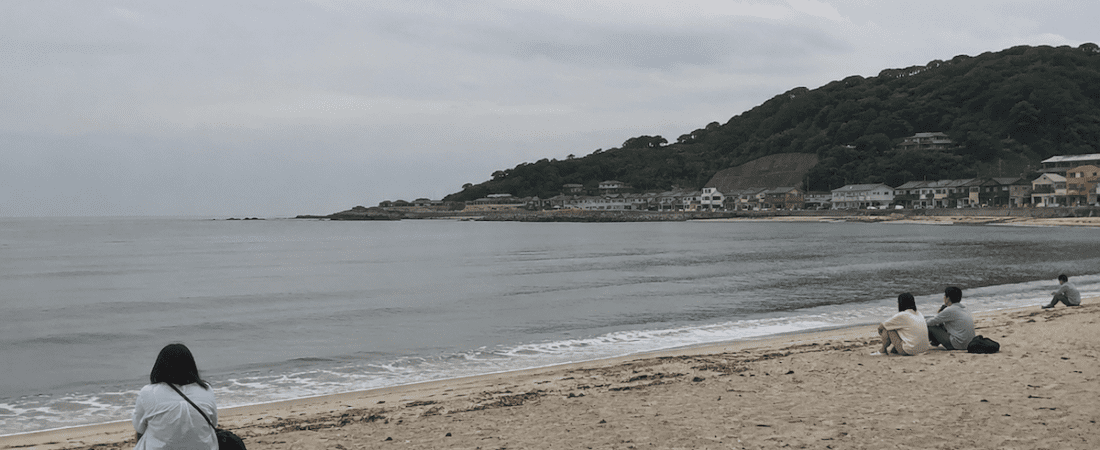
Visit a Japanese beach in summer and you’ll notice something. Many people are not in the water. They’re beside it — sitting under parasols in full UV-protection gear, eating watermelon, watching the waves. The beach is a place to be near the water. Actually swimming out past the waves is something else entirely.
The ocean in Japan is also genuinely dangerous in many places. Strong currents, sudden drop-offs, typhoon swells. For a country that lives with typhoons, storm surges, and the memory of tsunamis, the sea is never only leisure. There’s a cultural caution around it that might look like fear from the outside, but feels more like respect from the inside.
Japan’s relationship with the sea is intimate, but not casual. The sea is scenery, food, memory, danger, and season. For most people, it is not a place you simply enter.
And now the school pools are disappearing too.
In recent years, school swimming programs have been quietly shrinking. Pools are aging and expensive to maintain. Some municipalities have started outsourcing lessons to private facilities — or cutting them altogether. The public system that made swimming feel universal is starting to outsource the skill back to families.
Which creates a new problem. The skill that was once delivered by the public school system, regardless of income, is becoming a function of what your parents can pay for. Swimming remains one of Japan’s most popular extracurricular activities. But not every child has access to extracurriculars.
There’s something quietly absurd about a country defined by its relationship to the sea producing adults who are uncertain in it.
But maybe it follows the same logic as everything else here: proximity doesn’t guarantee engagement. You can live next to something your whole life and never fully enter it.
The ocean is right there. It always has been.
Some people swim. Some people watch.
All of the above is one Japanese person’s interpretation. Treat it accordingly.



Leave a Reply