
Japan Says “Learn Our Rules.” But Where Are They Written?
On the difference between written rules, vague instructions, and the invisible expectations that nobody put on paper — and why even Japanese people are not always sure which one they are following.
Lately, whenever the conversation turns to inbound tourism or foreign workers or immigration, I keep hearing the same thing.
They should learn Japanese rules. They should understand Japanese culture before they come here. If you come to Japan, you follow Japanese rules.
I understand the feeling behind it. I really do.
This kind of demand is not uniquely Japanese. Many countries tell newcomers to learn the local language, respect local values, or adapt to local customs. France, Britain, the United States — each has its own version of this conversation.
So I am not saying Japan is the only country that tells outsiders to adapt.
But in Japan, what gets called “the rules” often reaches into a quieter layer: not only law, language, or public values, but atmosphere, timing, hesitation, silence, distance, and knowing which expectation matters in that particular moment.
That is what I want to look at more carefully.
Because I write this blog. And writing this blog means I spend a lot of time trying to put into words things that Japanese people — including me — usually leave unspoken. And when I hear “learn Japanese rules,” something keeps catching.
Wait. Which rules?
Where, exactly, are they written?
Because I am Japanese, and I am not always sure.
Not All Rules Are Rules in the Same Way
Let me try to separate something that usually gets lumped together.
When Japanese people say “the rules,” they tend to mean at least three very different things. Sometimes all at once, without noticing.
A. Written rules
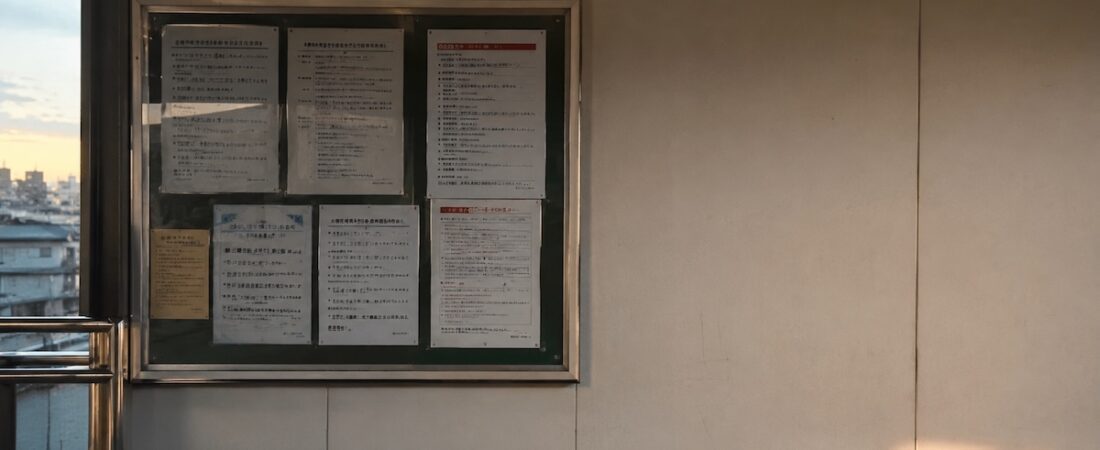
Laws. Facility regulations. Traffic rules. Garbage disposal schedules. No-smoking signs. Notices on the train. Terms of service. Instructions printed on the wall.
These are written. In Japanese, sometimes in English, occasionally in other languages. They are clear enough that if you cannot read them, you can look them up or ask.
B. Written-but-vague rules
Rules that exist on paper, but whose meaning depends entirely on context.
Please be considerate of other passengers. Do not disturb those around you. Use this space quietly. Follow proper manners. Please act with moderation.
These are technically written. But they do not tell you where “considerate” ends. They do not define how loud is too loud, how much space is too much, what counts as a disturbance and what does not. The words are there. The line is not.
C. Unwritten operating rules
Things that are never written anywhere, but that function, in practice, as strong social rules.
Reading the atmosphere. Knowing when to speak and when to stay silent. Understanding when an apology is expected even if no one asks for one. Feeling when a group has reached a conclusion without anyone saying so. Knowing which rule, in this particular moment, takes priority over the others.
These are real. They shape how Japan actually works, every day, in ways that matter. But they were never written. They were absorbed. Over years. Through correction. Through getting it wrong and adjusting.
These three categories look the same from the outside. They are all called “Japanese rules.” But they are not the same thing. And asking someone to follow all three before they arrive — or even shortly after — is asking for something that Japanese people themselves could not have done.
Written Rules Are Not the Problem
Let me be clear about something, because this article could easily be misread.
This is not an argument that foreigners should not have to follow Japanese rules.
Written rules are not the difficult part. If a rule is clearly stated — on a sign, in a law, on a posted notice — everyone should follow it. Japanese or foreign, tourist or long-term resident, it does not matter. “My home country is different” is not a reason to ignore a clearly written rule. That argument does not work in Japan, and it does not work anywhere else either.
If someone is damaging shared spaces, ignoring posted restrictions, or disrupting the safety or cleanliness that residents depend on, that is a problem. A real one. Not a cultural misunderstanding.
But.
The difficulty starts when written rules, vague instructions, and unwritten expectations are all treated as the same category — and presented to newcomers as “the rules you need to learn.”
Because they are not the same category. And the confusion between them creates problems that neither side fully sees.
The Hard Part Is the Rules Around the Rules
The second layer — written-but-vague rules — is where things get genuinely complicated.
Please be considerate. Fine. But considerate of what? Compared to what standard? At what point does someone cross from acceptable to inconsiderate? Who decides, and by what method?
In Japan, those answers are usually not given. They are felt. They are read from the faces of the people around you. They are learned from the moment when someone looks uncomfortable, or moves away slightly, or says nothing but clearly wants you to stop.
Every society has norms that are technically written but practically cultural. I cannot prove that Japan has more of this layer than every other society. But living here, I often feel how densely it is applied.
For someone who did not grow up inside that consistency, learning this layer takes time. Real time. Not reading-time. Living-time.
Learning this layer is useful — not because foreigners must become Japanese, but because it makes Japan less exhausting to navigate. Once you have a feel for it, the small social signals that used to be invisible start to become readable. The atmosphere becomes less opaque. The friction decreases.
But that takes proximity. It takes mistakes. It takes being on the receiving end of a quiet correction and understanding, slowly, what it meant.
You cannot study your way into this layer. You can only live your way into it.
Even Japanese People Are Guessing
Here is something I should say directly.
Japanese people do not simply know the correct answer. We guess. We get it wrong. We get corrected. We adjust. We guess again. And after enough cycles of that, we start to develop a feel for which guess is more likely to be right in which context.
That is not the same as knowing.
I have been corrected for being too quiet. For being too direct. For stepping in too quickly and for waiting too long. For saying something that was true but poorly timed, and for staying silent when speaking would have been better.
Not in different countries. In Japan. By Japanese people. In different situations.
Speak up more. Be assertive. Three years later, in a different room: Read the atmosphere. You are being too direct.
Show initiative. Move on your own. Later: Why didn’t you check with us first?
Follow the rules. And then: In this case, we need to be flexible.
Both of those things are true. Both are “the Japanese way,” depending on context, depending on who is in the room, depending on factors that nobody announces in advance.
Even Japanese people often learn these rules not by being taught, but by being corrected after choosing wrong.
Maybe that is not simply a failure of the system. Maybe it is part of how the system has always worked. But it means that asking someone to “learn Japanese rules” before they arrive — as if those rules are a clear, consistent, teachable set — is describing something that does not quite exist in that form.
When Rules Collide
There is another layer of difficulty that rarely gets named.
Japan has many rules. But some of them pull in opposite directions. And when two rules collide, there is usually no official rule about which one wins.
Be on time. Also: do not leave before everyone else.
Do not inconvenience others. Also: do not draw attention to a problem publicly.
Follow procedure. Also: read the situation and adjust.
Japanese people navigate these collisions constantly. They do it through something that might be called feel — a sense, developed over time, of which value takes priority in this kind of situation, with this kind of person, at this kind of moment.
That feel is real. It works. It keeps a lot of things running smoothly that would otherwise break down.
But it cannot be explained in advance. It cannot be handed to someone as a checklist. And when it fails — when two people’s sense of priority differs — neither one can easily point to a written rule and say: here, this is what it says.
The difficult part is not only learning Japan’s rules. It is learning which rule wins when two rules collide.
The Real Problem Is the Confusion
I have written before about why Japan has so many rules, and why even Japanese people struggle with them. But this article is about something slightly different: what we are actually calling a rule in the first place.
The problem is not that Japan has many rules. Every society has rules. Complex rules. Contextual rules. Rules that visitors find confusing.
The problem is that Japan often mixes written rules, vague instructions, and unwritten social expectations — and calls all of them “the rules.” And then asks people to follow them with equal seriousness, as if they were all the same kind of thing.
And the further problem is that many Japanese people have not thought carefully about this distinction. Not because they are careless. But because if you grew up inside the system, you absorbed all three layers together. You never had to separate them. They feel like one thing, because they always worked together.
But they are not one thing.
When a Japanese person says learn the rules, they may be talking about Category A. Or Category B. Or Category C. Or some combination of all three. And they may not realize, in that moment, that they are asking for very different things at the same time — some of which are perfectly reasonable to require, and some of which took them decades to partially understand.
That confusion is not unique to Japan. But naming it might help.
Making Rules Visible Is Not Giving Up Japan
Japan does not need to eliminate unwritten expectations. A significant part of what makes Japan’s public spaces work — the quiet trains, the clean streets, the instinctive orderliness under pressure — comes from those shared, unspoken understandings.
That is real. It is worth protecting.
But if the number of people who did not grow up inside that understanding is increasing — and it is — then some of that has to become speakable. Not all of it. But some of it.
Because the alternative is a system that functions well only for people who already know how it works. And that is becoming a narrower and narrower group.
Making invisible rules visible does not make Japan less Japanese. It may be how Japan keeps what is worth keeping.
Or, put more quietly:
Maybe explaining the rules is not the end of Japanese culture. Maybe it is how Japanese culture survives contact with people who did not grow up inside it.
I am not going to end this by saying Japan needs to change everything. Or that foreigners can do whatever they like. Both of those would miss the point.
The point is simpler than that.
Which rules are we talking about?
Because the answer matters. Written rules and invisible expectations are not the same thing. Asking people to follow both with equal fluency — immediately, upon arrival — is asking for something that took most Japanese people a lifetime of guessing and adjustment.
That does not mean letting go of what Japan cares about. It means being a little more honest about what, exactly, we are asking people to do.
I cannot change how an entire society talks about this by writing one article.
But I can try to separate what is written from what is assumed.
If this blog can help make one invisible expectation a little easier to see — for someone who just moved here, or someone who has lived here for years and still feels occasionally lost, or even for a Japanese person who never had to name what they already know — maybe that is worth something.
Maybe that is already something.
All of the above is one Japanese person’s interpretation. Treat it accordingly.



Leave a Reply