
Japan Calls It TPO. What It Really Tests Is Soyou.
The first time I heard the word TPO, I was in my early twenties, fresh out of school, sitting in a company meeting.
Someone asked if anyone had anything to add. I did. So I said it.
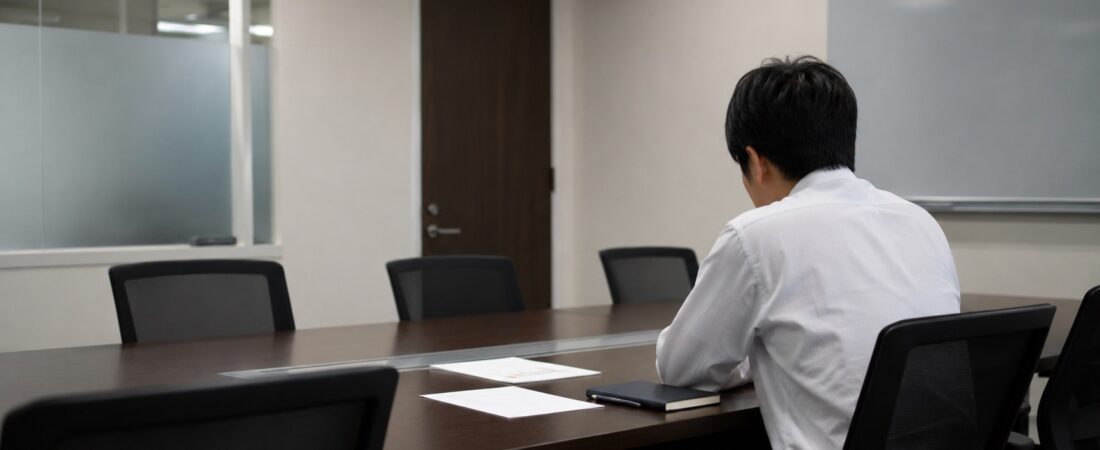
Later, a senior colleague pulled me aside. Not to tell me I was wrong. Just to explain that there is a time, a place, and an occasion for everything — and that particular meeting had not been the right one.
I had never heard the word before. Nobody had taught it to me. And yet, apparently, I was already being judged by it.
What TPO means — and why you’ve probably never heard of it.
TPO stands for Time, Place, Occasion. It looks like an English acronym, and the words are English, but the concept is Japanese in the way only Japanese English can be. It was popularized in the 1960s by Kensuke Ishizu, the fashion entrepreneur behind VAN Jacket, as a way to teach postwar Japan how to dress appropriately for different situations. The idea spread well beyond fashion, eventually becoming shorthand for something much broader: knowing how to behave in a way that fits the moment.
You will not find TPO used this way in ordinary English. There is no direct equivalent, though “there’s a time and place for everything” gets close. The fact that English needs a whole sentence to approximate what Japanese captures in three borrowed letters says something.
What TPO points at — behaving appropriately for the context — exists everywhere. But the Japanese version carries something extra. It is not just about knowing the rules. It is about having internalized them deeply enough that you do not need to think about them.
That deeper thing has a name too: soyou.
What soyou actually means.
Soyou (素養) is the accumulated groundwork inside a person: knowledge, manners, judgment, taste, and the ability to respond appropriately without being walked through every step.
It appears in small things. How you hold your chopsticks. Whether your shirt is ironed. How you apologize. Whether you can read a room. Whether your behavior changes depending on who is present and what the situation calls for.
Soyou is not about perfection. It is about whether the right instincts are there — whether, when the moment comes, you respond in a way that acknowledges the people around you and the context you are in.
The person with soyou does not just know that there is a time and place for everything. They feel it, without having to be told.
Why this is different in Japan.
In most countries, this kind of social refinement is class-based. In the English-speaking world, “breeding” or “social grace” signals old money, private school, a particular kind of upbringing. If you were not raised with it, acquiring it later marks you as an outsider trying to pass.
Japan is different, for a reason rooted in its postwar history.
Japan came to see itself as unusually socially and economically homogeneous — a nation of ordinary middle-class people, captured in the phrase ichioku sōchūryū: “one hundred million all middle class.” Whether this was ever fully true is less important than the fact that people believed it, or were expected to behave as if it were true.
Alongside this came a remarkably uniform educational system: the same curriculum, the same expectations, delivered to nearly every child regardless of family income or geography.
This meant that the cultural knowledge embedded in Japanese society — the etiquette, the awareness of hierarchy, the understanding of appropriate behavior — was theoretically available to everyone. Soyou was not imagined as a privilege of the wealthy. It was treated as a shared baseline. Something everyone was expected to acquire, because everyone had roughly the same opportunity to do so.
Which is why, when someone in Japan lacks it, the judgment is different from what it would be in a class-based society. It is not “they weren’t raised with it.” It is something harder to name — closer to a missed opportunity, or a choice not made.
The invisible scoring system.
Soyou functions as a kind of invisible parameter by which people in Japan assess each other — often without realizing they are doing it.
Chopstick grip. Posture. The way someone enters a room. Whether they pour for others before themselves. How they phrase a refusal. Whether an apology addresses only the immediate incident or acknowledges the wider web of relationships it affected.
None of these things are announced as tests. None of them have official weight. But they accumulate. The colleague who holds their chopsticks oddly. The junior employee whose apology explained nothing. The person who spoke up at the wrong meeting.
Each data point, on its own, means little. Together, they form an impression that is very difficult to undo — and that the person being assessed may never know is being formed.
The particularly Japanese quality of this system is its silence. In a more explicit culture, you might be told: “That was not the right moment.” “Your apology needed more context.” “The way you said that came across poorly.” In Japan, you are more likely to feel the effects without ever being given the cause.
When the invisible scorecard starts working against you, it does not announce itself. The feedback arrives as a thermal decline. Smiles remain intact. Politeness is maintained. But the room gets slightly colder. Emails take a little longer to come back. The after-work invitations quietly thin out. Important conversations begin happening in rooms you are not in. Nobody says anything. Nobody needs to. You are being moved, gently and without friction, toward the outside — the way a body’s immune system handles something it has decided does not belong.
What nobody tells you.
The problem with soyou — and this is true for Japanese people as much as for anyone else — is that you cannot know what you are missing.
If you have never had to think about the timing of a comment in a meeting, you do not know that timing matters. If nobody has ever explained that an apology in Japan is expected to address more than the immediate incident, you will write a two-line statement and wonder why the room is still cold. If the concept of TPO was never introduced to you, you will say the right thing at the wrong moment and have no framework to understand why it landed badly.
The disadvantage of not having soyou is invisible to the person who lacks it — because the skill required to notice the disadvantage is the same skill they are missing.
I learned this the hard way, in that meeting, in my twenties. But at least I was told. The colleague pulled me aside. He gave me the word. Once you have the word, you can start to see the concept. Once you see the concept, you can start to build toward it.
Not everyone gets that conversation.
A final thought for anyone working in Japan.
Soyou is not something you can acquire overnight. It is not a checklist. There is no certification.
But understanding that it exists — that there is a system of invisible assessment running quietly alongside every professional interaction in Japan — is already more than many people have.
You do not need to be Japanese to develop it. You do not need to have been raised with it. But you do need to know it is there.
The people who know it is there, and work toward it, tend to do better. Not because Japan rewards perfection. But because soyou, at its core, is just sustained attention to the people around you — and that is rarely wasted anywhere.
All of the above is one Japanese person’s interpretation. Treat it accordingly.



Leave a Reply