
Nomikai: What the Guidebooks Don’t Tell You
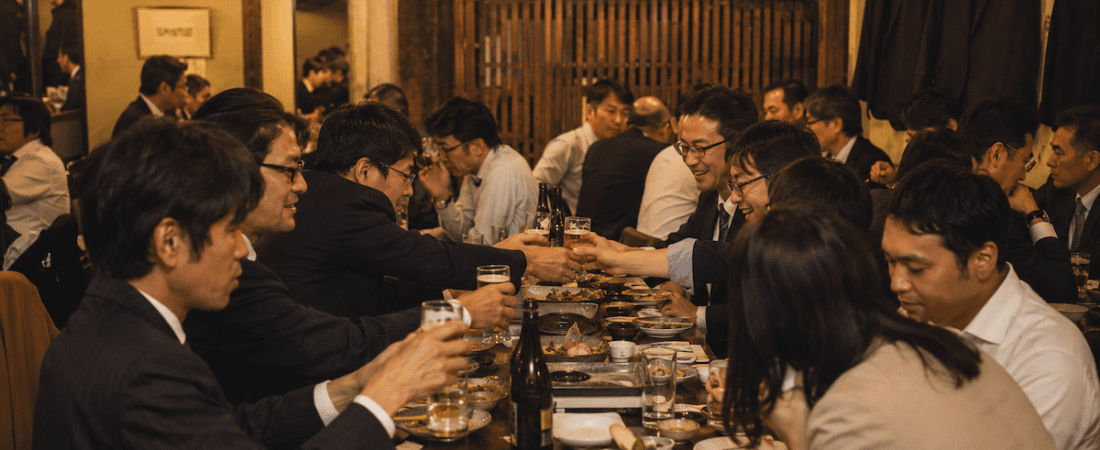
A nomikai is a Japanese work drinking party. It usually happens after office hours, often at an izakaya, and it is commonly explained as a chance for coworkers to relax, bond, and speak more openly.
That explanation is not wrong.
But it is too clean.
If you only understand nomikai as Japanese office drinking, you will miss what it actually does inside the workplace.
There are plenty of articles about nomikai. Most of them cover the same ground: what it is, the rules, the etiquette, the types. Bring cash. Don’t pour your own drink. Respect the seating order. Arrive on time.
That information is accurate. It is also almost entirely useless for understanding what a nomikai actually is.
What nomikai is for Japanese people
At its core, nomikai serves a function that no amount of polite office interaction can replicate: it is the place where the performance briefly slips.
Japanese workplace life runs on layers. There is what you say and what you mean. There is how you behave in front of your boss and how you feel about your boss. There is the meeting where everyone agrees and the hallway conversation afterward where the real opinions come out. The sociologist would call this high-context communication. The Japanese word is tatemae — the public face — versus honne — what you actually think.
Nomikai is where tatemae gets a night off.
Of course, tatemae does not disappear. It changes costume. The hierarchy is still there. The seating order still matters. The boss is still the boss. But the performance loosens enough for something else to show through. Nomikai is not the opposite of the office. It is the office after the lighting has changed.
This works partly because of alcohol, and partly because of something specific about how alcohol functions in Japan. Japanese people, as a group, tend to have lower alcohol tolerance than many Western counterparts — a biological reality that affects a significant portion of East Asian populations. But that is only part of the story. The deeper reason is that in a culture built on tatemae, conformity, and shame-consciousness, the social permission that comes with drinking is unusually powerful. Alcohol provides an excuse. He said that, but he was drunk. It creates a sanctioned space for behavior that would otherwise be unthinkable.
The result is that the same person who sat through three hours of a meeting without expressing a single personal opinion might, after two beers, tell you exactly what they think of the new management strategy. The colleague who has never once raised their voice in the office might be singing at the top of their lungs at karaoke an hour later. I once watched a senior colleague — famously quiet, almost severe in the office, the kind of person whose approval nobody could quite read — absolutely lose himself at a karaoke bar. I barely recognized him.
That is not a malfunction of the system. That is the system working exactly as intended.
Recent surveys regularly show that many Japanese workers, especially younger ones, no longer see workplace drinking events as necessary. And yet many still go. That gap tells you something: nomikai is not really optional, even when it is technically optional. It is the ritual through which the group reaffirms that it is a group.
Part of why nomikai carry so much weight is that Japanese workplaces leave a lot unwritten: roles, responsibilities, expectations, and even where work actually ends.
The wrong way to think about nomikai
There is a certain kind of person who goes to a nomikai and comes back with a verdict: it is a ritual of conformity, a performance of hierarchy, a mechanism of social control dressed up as a party. They are not wrong, exactly. If you sit at the edge of the table nursing a glass of Oolong Tea, watching everyone else get progressively louder, analyzing the seating arrangements and cataloguing who pours for whom — yes, it will look exactly like that.
But that is a bit like attending a baseball game and spending the whole evening reading the rulebook. Technically accurate. Spiritually useless.
In Japan, you don’t attend a nomikai to study the hierarchy; you attend to let the hierarchy dissolve. You don’t need to overthink the rules. Just lower your guard and let the alcohol and the architecture of the izakaya do their work.
The people who describe nomikai as a cold exercise in corporate ritual are usually the ones who went but didn’t really arrive.
What nomikai is for everyone else
Here is where the standard articles miss something important.
Everything written about nomikai is written from the perspective of a Japanese person navigating Japanese social dynamics. The etiquette guides, the rules about hierarchy, the warnings about not refusing the boss’s invitation — all of it assumes you are trying to function within the system the way a Japanese person would.
But if you are a foreign colleague, you are not inside that system in the same way. You are not expected to read the air with the same precision. The consequences for getting things wrong are different. The rules, in a meaningful sense, apply to you differently. Not because you are above the rules. Because you are not fully written into them.
Which means nomikai is a completely different experience depending on which side of that line you are on.
For Japanese colleagues, nomikai is where hierarchy gets performed and occasionally relaxed. For you, it is something else: it is the only place where you will see what your Japanese colleagues are actually like.
The Japanese workplace keeps most of its social machinery invisible to outsiders. The careful management of who defers to whom. The real feelings about the project that nobody mentioned in the meeting. The person who is struggling. The person who is quietly frustrated. The friendships and frictions that govern how things actually get done. In the office, these things are hidden. At nomikai, they surface.
You will see the dynamics that every article on Japan tries to explain — and fail to fully capture — playing out in real time. Who sits where and why. Who pours whose drink and what that means. Whether someone picks up the karaoke microphone or hands it away. Whether the boss performs authority or quietly sets it down for the evening. The unspoken negotiation over the bill. All the things that are invisible in normal working hours become briefly readable.
If you have read anything about Japanese workplace culture — the concepts, the frameworks, the dynamics — nomikai is where you see them in the wild.
So should you go?
If you have the chance, yes — but with the right expectations.
Not because your attendance will transform your relationships overnight. Not because skipping will damage your career — the dynamics that govern Japanese workers’ nomikai attendance mostly do not apply to foreign colleagues in the same way.
Go because it is the clearest window you will get into the reality of the workplace you are in.
You will not become an insider. That is not what nomikai does for foreign colleagues. But you will understand the room you are working in better than you did before. The colleague who seemed cold might turn out to be shy. The manager who seemed approachable might reveal a more formal edge. The team dynamic that seemed smooth might show its actual tensions.
And then there is the morning after.
The person who spent the previous evening with their arm around the boss’s shoulder, singing off-key and saying things that would never survive a meeting — that same person will be at their desk at nine the next morning, shirt pressed, posture correct, greeting you with a perfectly composed ohayou gozaimasu. As if none of it happened. Because, socially, none of it did. The evening is sealed when you leave the izakaya. What was said stays there. This is not denial. It is the mechanism that makes the whole system possible. The reset is what allows people to go all the way in — because they know, without needing to be told, that the door back is always open.
Recent surveys suggest that around 60% of younger Japanese workers now consider nomikai unnecessary — a shift driven by changing attitudes toward work-life balance. That is a reasonable way to live. But there is something to be said for occasionally walking into a room you did not plan to be in.
Go once. If it is not for you, you never have to go again. But go having actually arrived — not standing at the edge with a notebook, but in the middle of it, letting the evening unfold.
The office shows you the performance. Nomikai shows you something closer to the person.
All of the above is one Japanese person’s interpretation. Treat it accordingly.


Leave a Reply