
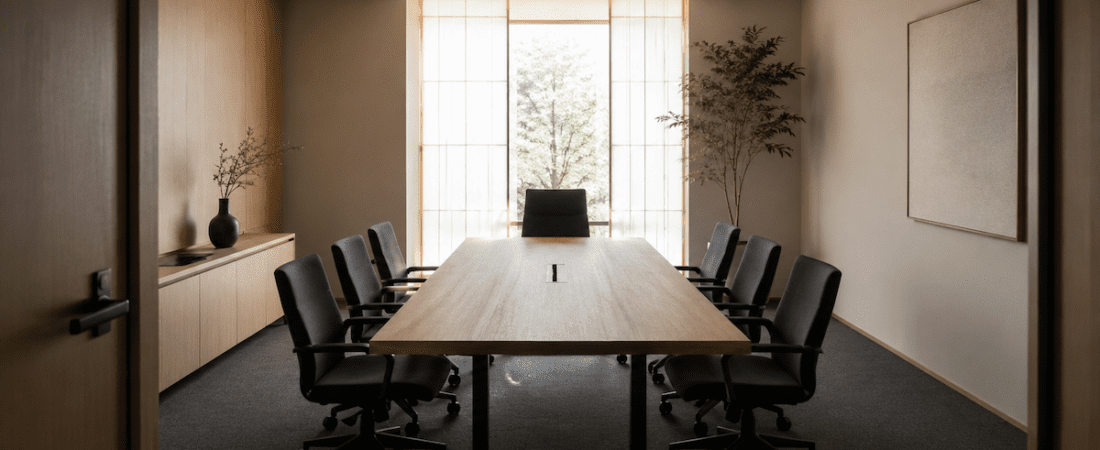
Kamiza and Shimoza: Japan’s Invisible Seating Hierarchy
Most foreigners walk into a Japanese meeting room and sit down wherever seems convenient. Near the door. Near the window. Wherever the bag lands.
Nobody says anything. But something has been registered.
It Started With Assassins.
One common explanation starts with assassins.
The seating hierarchy in Japanese meeting rooms — kamiza (上座) and shimoza (下座) — traces back to Japan’s warrior-class society. Physical positioning wasn’t ceremonial. It was tactical.
The seat farthest from the door was the safest. No sudden attack could reach the lord before passing through everyone else. The most junior retainers sat closest to the entrance — first in the line of danger, first to absorb whatever came through the door.
That logic calcified into etiquette over centuries. The lord became the senior executive. The retainers became the junior staff. The door stayed the door.
The Rule, Simply Put.
The seat farthest from the entrance is kamiza — the seat of honor, reserved for the most senior person in the room, or the guest of honor.
The seat closest to the entrance is shimoza — the lowest seat, taken by the most junior person present.
When both sides of a negotiation are present, the most senior person from each side sits farthest from the door, facing each other across the table. Their teams arrange behind them in descending order of rank, toward the door.
As a general rule, this applies in meeting rooms, restaurants, taxis, and elevators. In a taxi, the seat behind the driver is kamiza. The front passenger seat is shimoza. In an elevator, the person standing at the control panel — pressing buttons, holding the door — is in shimoza. That’s the junior person’s job.
Does Anyone Still Care?
It depends entirely on the company and the generation.
In older, traditional organizations — manufacturing, finance, anything with a strong seniority culture — these rules are taken seriously. New employees are taught them explicitly. Getting it wrong reflects on the company, not just the individual.
In younger tech startups, the rules are often ignored entirely. Flat seating, no assigned positions, everyone sits wherever.
But here’s where it gets interesting. Even in progressive companies, when an important external client walks in, the seating instinct activates. It’s not a rule being followed. It’s a reflex.
And you can see that reflex in the doorway, before anyone has even sat down.
When a group of Japanese colleagues arrives at a meeting room, there’s often a brief, strange moment at the entrance. Nobody rushes in. There’s a subtle exchange — “after you,” “no, please, after you” — and then, almost imperceptibly, people drift toward their positions. It looks like hesitation. It isn’t. Everyone is running a rapid silent calculation: role, seniority, relationship, context. The room arranges itself without a word being said.
The Shimoza Isn’t Just the Lowest Seat. It’s the Working Seat.
This is the part that most explanations miss.
The shimoza — the seat nearest the door — is positioned there for a reason beyond hierarchy. It’s where the person who does things sits.
At a dinner, the shimoza person orders the food, refills the drinks, calls for the car, pays the bill. At a meeting, they’re the one who darts out to make copies, answers the door, handles logistics. The seat closest to the entrance is closest to the action — the kitchen, the corridor, the world outside the room.
It’s not just the lowest seat. It’s the most functional one. Whoever sits there has implicitly agreed to be the person who moves.
I’ve been in enough meetings and dinners to say this clearly: it’s not something anyone announces. Nobody says “you’re in shimoza, so go get the drinks.” It’s simply understood. The person in that seat knows what’s expected, because the design of the room tells them.
Why This Matters If You’re Foreign.
If you walk into a Japanese meeting room and sit in the wrong seat, nobody will tell you. Not directly. But it will be noted.
A young Japanese employee who takes the kamiza seat ahead of their seniors communicates something specific: this person doesn’t know the basics. And by extension: whoever trained them didn’t either. It reflects on the company. That’s how seriously it’s taken in traditional settings.
For a foreigner, the calculus is slightly different. If you sit in the wrong seat, the reaction is more likely to be: well, they’re foreign. It won’t be held against you in the same way.
But here’s the flip side.
A foreigner who gets the seating right — who quietly takes the shimoza, guides the senior guest to the kamiza, understands the spatial logic of the room — sends a very different signal. Not just “this person knows the rules.” Something closer to: this person understands us.
That impression doesn’t come from following a checklist. It comes from understanding why the seats are where they are.
The Practical Version.
When you walk into a Japanese meeting room, especially for a formal external meeting:
Wait before sitting. The default in Japan is to remain standing until invited to sit or until the seating order becomes clear.
If you’re the guest, you’ll likely be guided to kamiza. Accept it.
If you’re the host or the junior person, take the seat nearest the door. And be ready to move.
All of the above is one Japanese person’s interpretation. Treat it accordingly.
Leave a Reply