
Foreigners in Japan Get a Pass. It’s Not Always a Compliment.
Something happens when you live in Japan long enough and pay close enough attention.
A foreigner talks on their phone on a crowded train. The people around them say nothing — though the silence isn’t empty. There’s a brief, sharp glance. A quiet shift in posture. The disapproval is there. It just doesn’t land on the foreigner the way it would on someone inside the system. A Japanese person does the same thing on the same train. The reaction is different.
This isn’t a small observation. It points to something structural about how Japanese society relates to people from outside it — and I think it’s worth saying clearly, because guidebooks and practical explainers rarely touch it.
The Gaijin Seat
Let’s start with something small and visible.
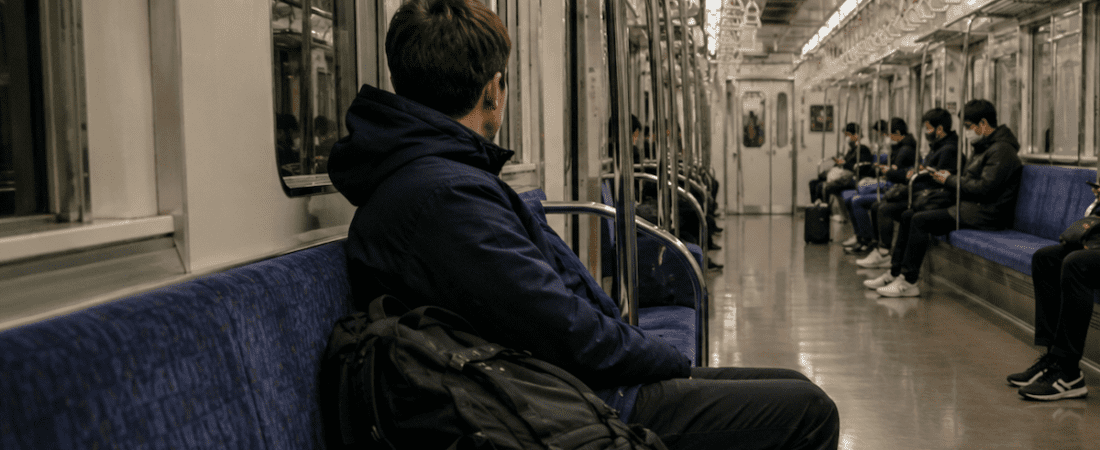
In Japan, there’s a phenomenon well-known among foreigners who live here: the Gaijin Seat. You sit down on a train, and the seat next to you stays empty. The train fills up. People stand. But somehow, nobody sits beside the foreign passenger.
It’s not universal. It doesn’t happen everywhere, and plenty of foreigners report never experiencing it. But it’s real enough to have a name — in both Japanese (gaijin shīto) and in English — and it’s real enough that some foreign residents have joked about it as a perk. Free space on a crowded train. Nobody bothering you.
I understand the humor. But I think the humor misses what’s actually happening.
Sometimes it probably is prejudice. Sometimes it is uncertainty. Often, it is not conscious at all. But in each case, the foreigner has been placed outside the usual calculus. Sitting next to someone in Japan means being within range of interaction — however small. With a foreigner, there’s an unspoken assumption that the normal rules of that interaction might not apply. Different language. Different customs. Unknown territory. Easier to stand.
The foreigner isn’t being rejected. They’re being placed outside the usual system.
Different Behavior, Different Measurement
Here’s the deeper pattern.
When a Japanese person breaks an unspoken rule — talks too loud on the train, mis-sorts their garbage, takes up too much space — they’re measured against a shared standard. There’s an assumption: you grew up here, you know better. The reaction reflects that.
When a foreigner does the same thing, the starting assumption is different: they probably don’t know. The same behavior gets read through a different lens. Not better or worse, necessarily. Just separate.
The result is that foreigners often operate under a different — and frequently more lenient — set of social expectations. Not because Japanese people are being generous. But because the foreigner has been categorized differently from the start.
I had a small experience that made this concrete for me. I was on a train with a foreign colleague. Her phone rang and she answered it briefly — the doors were still open, the train hadn’t moved. An elderly man nearby said something. He directed it at me, not at her.
I’ve thought about that moment a lot. My read is that he spoke to me because I was Japanese — because I was, in his view, the person who should know better, the person responsible for maintaining the standard. She was outside that system. I was inside it.
Whether I’m right about his reasoning, I genuinely don’t know. But it felt that way.
This Is Not a Privilege. But It Is One.
In practical terms, it can feel like a privilege. Socially, it is also distance.
The fact that foreigners are held to different standards in Japan is not simply a perk — not an invitation to behave however you want because nobody will stop you.
Being outside the system isn’t freedom. It’s a form of distance. The same mechanism that means nobody will scold you for talking on the train is the mechanism that means you’re not fully counted as part of the social fabric.
You’re a guest. In Japan, guests are treated with great care — okyaku-sama, the honored customer, the welcome visitor. But a guest is not family. A guest is not consulted on the decisions that matter. A guest is received warmly and kept, gently, at a certain remove. Guests get more latitude. But guests are also, by definition, not at home.
The pass is real. So is the wall.
Some foreigners spend years in Japan, learn the language, build lives here, and still find that many visibly foreign residents are treated as perpetual visitors. The latitude and the distance are the same thing.
It’s Changing. But Slowly.
Japan has seen a significant increase in foreign visitors and residents in recent years, and the old assumptions are being tested. More Japanese people speak English. More have traveled internationally. More have foreign colleagues, neighbors, friends. The idea that foreigners simply “don’t know” is harder to sustain across the board.
There are Japanese people who would push back on everything I’ve written here. Who would say the distinction I’m describing doesn’t match their experience or their view of how Japan works. I think they’re right that it isn’t universal. I think they’re wrong that it isn’t real.
The phrase meiwaku gaikokujin — “nuisance foreigner” — now appears in media and online discussions about badly behaved visitors. A tourist did pull-ups on a sacred torii gate at a Shinto shrine in Japan in 2024, posting the video to social media. It caused genuine outrage.
That incident is not the same as the everyday double standard I’m describing. But they’re related. Both are symptoms of a society still working out what it means to have a large and permanent foreign presence, rather than just visitors who pass through.
What I Actually Want to Say
I’m not writing this to tell foreigners that Japan is secretly unwelcoming, or that the latitude you experience is a trap. Japan is genuinely hospitable in many ways.
I’m writing it because I think understanding your actual position in a society matters. And the actual position of many visibly foreign residents in Japan — even long-term residents — is guest. Not outsider in a hostile sense. But not fully inside either.
That position comes with certain freedoms. It also comes with a kind of invisibility, a not-quite-counting that can feel comfortable until it doesn’t.
Use the latitude to make mistakes and learn. Don’t use it as a reason to do whatever you want. The torii gate is not a gym. The train is not your living room. The fact that nobody stops you doesn’t mean you’re not being seen.
All of the above is one Japanese person’s interpretation. Treat it accordingly.



Leave a Reply