Japan Has Manga About Everything. Of Course It Does.
Most people outside Japan think of manga as entertainment. Something teenagers read. Something with big eyes and dramatic hair.
That’s not wrong. But it’s about a quarter of the picture.
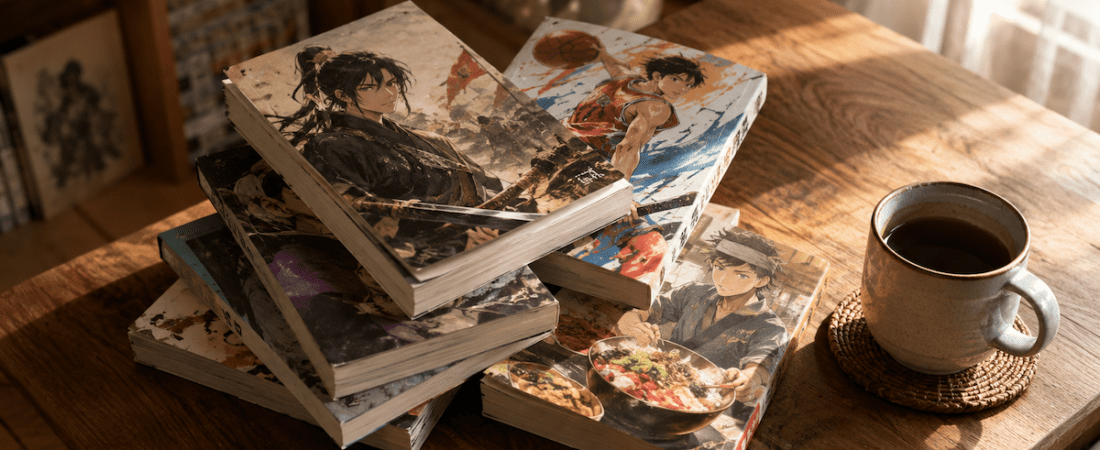
Japan has manga about surgery. About tax law. About fermentation. About the philosophy of Socrates. About competitive bread baking. About a modern chef who time-travels to the Sengoku period and cooks for Oda Nobunaga.
There is manga for children, manga for salarymen, manga for elderly women, manga for people who want to learn how the stock market works. Close to half of Japan’s entire publishing market, in recent industry figures, is manga. Not comics as a subcategory. Nearly half the entire publishing industry.
This is not a niche. This is infrastructure.
Other Countries Have Comics. Japan Has Something Different.
Other countries have educational and adult comics too. The difference in Japan is scale and normality.
In Japan, no one is surprised that a manga might teach you tax law, surgery, or fermentation. American comics have superheroes. French bandes dessinées have adventure and satire. Both are legitimate art forms with long histories. But the range of subject matter that manga covers — as a completely normal, unremarkable thing — is different in kind, not just degree.
The range isn’t accidental. It’s the result of a publishing ecosystem that has spent decades treating manga as a medium capable of covering any subject — not a genre confined to action and fantasy.
History Class Gave You Dates. Manga Gave You People.
I’ll be honest about something: I retained more Japanese history from manga than I ever did from a textbook.
School history in Japan is largely about memorizing dates and names. 1600, Battle of Sekigahara. 1868, Meiji Restoration. The information arrives as information — abstract, context-free, designed to be reproduced on a test and then forgotten.
Manga gives you a person. A face. A conflict. An emotion.
A Chef of Nobunaga — Nobunaga no Chef — is a good example. It’s completely fictional. A modern chef wakes up in the Sengoku period and ends up cooking for Oda Nobunaga. The human portrayal of Nobunaga is invented. The drama is invented. But the historical sequence of events follows the actual record, with dishes grounded enough that readers can imagine — and sometimes recreate — them at home.
I’m not claiming it’s a history textbook. It isn’t. But after reading it, you have a felt sense of the period — the political tensions, the geography, the power dynamics — that no list of dates ever produced in me.
That’s what images do. They create memory differently than text. When you read that Nobunaga unified the warring states, it’s a fact. When you watch a character navigate that world through food and survival, it becomes something closer to experience.
There may be something deeper here too. Japanese people think in kanji every day — characters that are not just sounds but images carrying meaning. The boundary between reading and seeing has always been more porous in Japanese than in alphabetic languages. Manga may feel natural partly because the language itself never fully separated text from picture.
Sports Are Something You Read, Not Just Something You Do.
In the United States, sports are something you play, watch on TV, or follow as a fan. The idea of sitting down to read about a sport — to learn its rules and tactics and emotional rhythms through a comic — is a little foreign to that culture.
In Japan, at least historically, many people didn’t have the time or space to actually play sports. Long work hours, small living spaces, demanding school schedules. But you could always read.
Sports manga filled that gap. And they did it thoroughly — not just dramatizing the action, but explaining rules, demonstrating technique, building the internal logic of competition so carefully that a reader who had never touched a volleyball or swung a golf club could follow every moment and understand what was at stake.
One Outs doesn’t assume you understand the psychological warfare inside a baseball game. It builds it, piece by piece — the mind games between pitcher and batter, the tactical manipulation of an entire team’s momentum. I have no interest in baseball. I never have. But I read it anyway, and understood every move. The sport becomes legible. The reader becomes a fan of something they may never play.
Why Does Manga Cover Everything? Honestly, I’m Not Entirely Sure.
The obvious answer is the weekly serialization model. Japanese manga runs in weekly magazines — Weekly Shonen Jump being the most famous — where stories compete for reader attention and survival. A series that loses readers gets cancelled. A series that keeps readers running for years becomes a cultural institution.
To keep readers coming back week after week, something has to develop. Usually it’s the protagonist. And protagonist development, in practice, often means learning — learning a skill, mastering a technique, understanding a world.
It might be that writers researched their subjects obsessively to make the work feel real. But there’s another layer: behind many serious manga is an editorial team working with actual experts. Medical manga with doctor supervisors. Legal manga with practicing attorneys. Historical manga with academic advisors credited in the back pages. The education in manga isn’t always accidental. Sometimes it’s engineered — a collaboration between storytellers and specialists that produces something neither could have made alone.
Whether that was always intentional, I honestly don’t know. But the result is a medium where entertainment and knowledge are not separated. Where reading for pleasure and learning something are often the same act.
If You Think Manga Is Just for Kids, You’re Missing Half of Japan
There’s a version of Japan that foreigners often encounter — the neon signs, the bullet trains, the efficiency, the politeness. That Japan is real.
But there’s another layer, harder to see, that runs through daily life on the train, in the convenience store, in the break room at work. Millions of adults, reading. Not novels. Not news. Manga.
A surgeon reading a manga about surgery. A chef reading a manga about food history. A salaryman reading a manga about a salaryman who starts a small business and gradually finds meaning.
The medium doesn’t condescend to its readers. It meets them where they are, in whatever world they’re curious about, and takes that world seriously.
That’s what makes it different. Not the art style, not the page direction, not the big eyes.
The willingness to believe that any subject — any human activity, any area of knowledge, any emotional territory — is worth making a manga about.
All of the above is one Japanese person’s interpretation. Treat it accordingly.



Leave a Reply