I Walk Home at 2 AM. Nothing Is Going to Happen.
It’s past two in the morning in Tokyo.
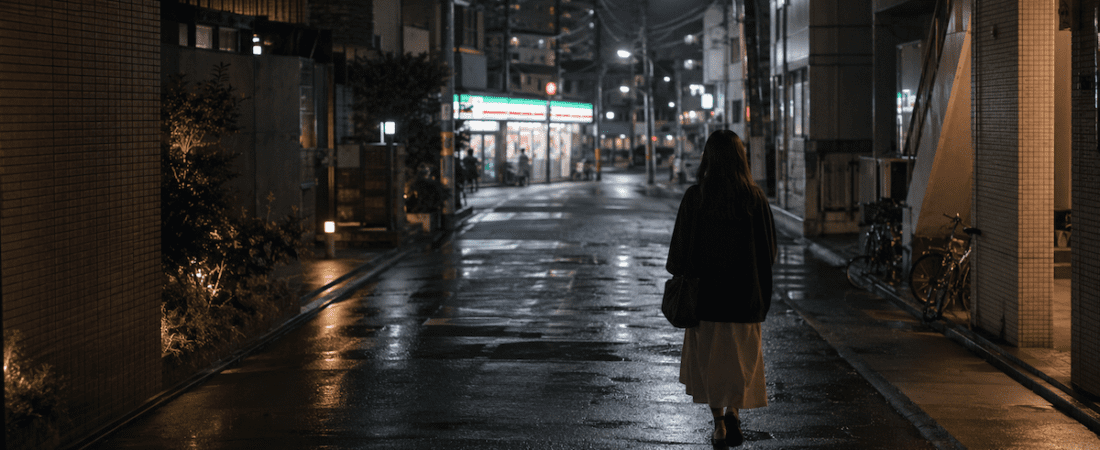
A young woman is walking home alone. Earphones in, unhurried pace, no visible concern about where she is or what time it is. A few blocks away, a group of three women in their twenties are standing on a street corner, deep in conversation, showing no intention of moving anytime soon.
If you’re visiting from most parts of the world, this stops you.
Not because it’s dangerous. Because it’s so clearly not.
Japan isn’t the only safe country in the world.
Safety exists elsewhere — in certain cities, certain neighborhoods, certain hours. What’s different about Japan is the texture of it. There are fewer places where the calculus changes dramatically after dark. The city feels less divided into safe and unsafe zones. It remains, recognizably, the city.
And Japan runs late. Shops open at ten, izakayas stay open until the early hours, and convenience stores never close at all. The streets at midnight aren’t empty because something is wrong. They’re populated because that’s just when things are happening. The last train home is a legitimate social institution — and for everyone who misses it, the city stays open anyway.
Which means the woman walking home at 2 AM isn’t an anomaly. She’s just part of a city that’s still awake.
The explanations you’ll find most often point to institutions.
Strict gun control, an efficient police force, a justice system with a high conviction rate. These things are real and they matter. Police, law, lighting, transport, and urban design all contribute.
But they’re not the whole story. Probably not even the main story.
Bad things happen in Japan. The difference is that public life is not organized around the expectation that they will.
Here’s what I think is actually happening.
Japan’s safety is not only enforced. It is also agreed upon. The majority of people here operate under a shared set of expectations about how public space works. You don’t disturb others. You don’t take what isn’t yours. You don’t make yourself a problem for the people around you. These aren’t rules that get posted on signs — they’re closer to the operating system that runs underneath everything else. Invisible until something violates it.
If you’ve read other pieces on this site, some of this will sound familiar. The same culture that produces silence on trains, that runs on unspoken social contracts, that treats queue-jumping as a serious offense — that culture also produces streets where a woman alone at 2 AM is not automatically treated as having made an irrational decision.
The safety is a byproduct of the same system.
This matters because it means Japan’s safety isn’t really exportable.
You can copy gun laws. You can increase police presence. You can build better street lighting. None of that replicates what’s actually happening here, which is a society where the vast majority of people have internalized the same assumptions about shared space and collective behavior — and where deviating from those assumptions carries real social cost.
That social cost is hard to legislate into existence. It accumulates over generations, transmitted through families and schools and the ten thousand small daily interactions that teach people how to exist alongside strangers.
It also means the system is fragile in ways that are difficult to talk about openly. The assumptions only hold as long as most people share them. When significant numbers of people no longer share the same assumptions — for any reason: alienation, poverty, anonymity, social fragmentation, or simply growing up in a different set of rules — the agreement starts to show hairline fractures.
This is not about nationality. Japanese people can opt out of the agreement too, and many foreign residents learn it quickly. It’s not a question of where you’re from. It’s a question of whether the shared software is running.
This is not an argument for or against any particular policy. It’s just an observation about how the safety actually works. Understanding the mechanism doesn’t tell you what to do with it. That’s a separate conversation.
What I can tell you is what it feels like from the inside.
It feels like a city that isn’t bracing for anything. Like the baseline assumption is that things will be fine, and people behave accordingly, and so things usually are.
Whether you notice that or not probably depends on where you’re coming from.
If you grew up somewhere that safety required vigilance — certain streets, certain hours, certain awareness of who was around you — Japan can feel disorienting. Not because it’s unfamiliar. Because the thing you were always preparing for never arrives.
That absence is its own kind of remarkable.
There’s a phrase in Japanese — heiwa-boke — that roughly translates to “peace-drunk.”
So accustomed to safety that you’ve lost the instinct to watch for danger. It gets used as a criticism, a warning about complacency.
It’s probably a fair point.
And yet. A society where most people have genuinely never had to brace for the worst — where that vigilance became unnecessary somewhere along the way — that’s not nothing. That’s actually quite hard to build.
Call it naive if you want. I’d rather it stayed.
All of the above is one Japanese person’s interpretation. Treat it accordingly.
Leave a Reply