
Karoshi Is Visible. The System That Produces It Isn’t.
Most foreigners who spend time in Japan eventually learn one Japanese word they didn’t expect to need.
Karoshi. Death from overwork.
The word now covers not only death from physical overwork, but also work-related mental illness and suicide. It makes international headlines periodically — a young employee at an advertising firm, a nurse, a factory worker — and each time it does, the same question surfaces: how does a modern, wealthy country allow this to happen?
It’s a fair question. But karoshi is the extreme end of a much larger structure. And that structure is changing — slowly, unevenly, but genuinely. Understanding overwork in Japan means starting somewhere more basic.
What is overtime, exactly?
In Japan, labor law defines the standard working day as eight hours. Any work beyond that is overtime — legally requiring proper labor-management agreements and premium pay. In practice, the cultural meaning of overtime often goes far beyond the legal definition.
But here’s the question that doesn’t get asked enough: why is there work left over at the end of eight hours in the first place?
In at least the workplaces I’ve seen, the eight hours were never designed to contain the work assigned. Whether that’s broadly true, I can’t say for certain — but the pattern was consistent enough to make me wonder. The job didn’t fit the container. And rather than fixing the container, the excess got a name — zangyou, overtime — and became a normal part of the day.
This is not a time management problem. It’s a design problem. The work was never properly scoped in the first place.
What’s missing is a design for completion.
A functioning plan would look something like this: Aさん handles this today, Bさん handles that, and together by end of week the project reaches this point. By end of quarter, we’re here. Whether reality cooperates is a separate question — it often doesn’t. But the act of constructing that plan, of defining what a completed day looks like, forces a conversation about what’s actually possible in the time available.
In many Japanese workplaces, that conversation never happens. Tasks get assigned without clear end states. Deadlines exist in theory but expand in practice. Nobody defines when done is done.
Without a destination, you can never arrive. So you keep working.
The asymmetry nobody talks about.
This shows up in a specific way that surprises foreigners who arrive expecting Japanese punctuality to apply universally.
Meetings start on time. That part is true — being late is taken seriously, and most people aren’t. But meetings frequently don’t end on time. A one-hour slot becomes ninety minutes. A morning session bleeds into lunch.
Start times are treated as commitments. End times are treated as suggestions.
It’s the same underlying issue. Japanese work culture has developed strong reflexes around beginnings — showing up, being present, demonstrating readiness — but weak ones around endings. Finishing on schedule requires defining in advance what finished means. That definition is often missing.
The economic dimension.
There’s also an economic dimension that rarely makes it into the international coverage.
Japanese base salaries, particularly for younger workers, have historically been low. The system was built around lifetime employment — the company takes care of you for forty years, and in exchange, you accept modest pay early in your career with the expectation that seniority will eventually bring more.
Bonuses exist, but they fluctuate with company performance. What doesn’t fluctuate is overtime pay.
For some workers, especially earlier in their careers, overtime pay became not just compensation for extra work, but part of how monthly income was expected to add up — in companies that actually pay it properly. The incentive structure rewards staying, not finishing.
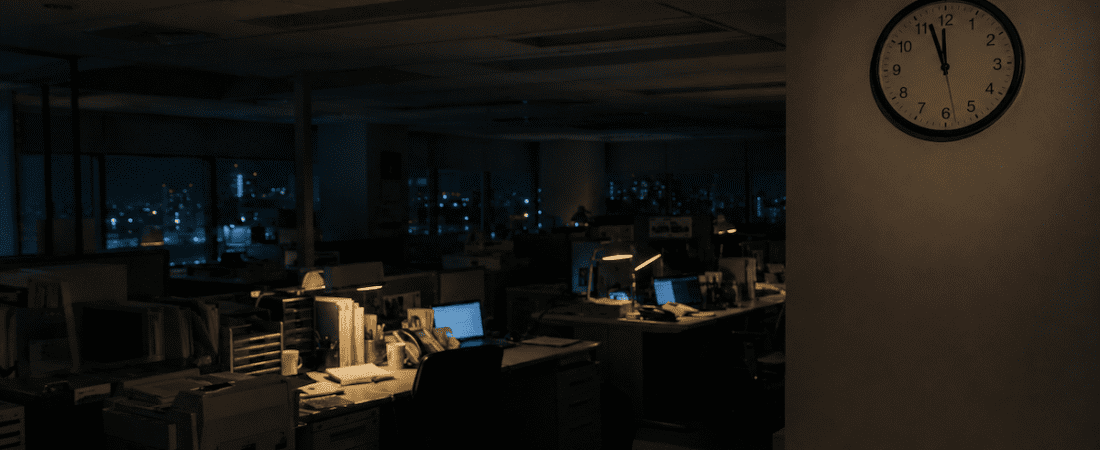
I worked at a company where some people were regularly at their desks until 2 AM. Their output was not proportional to their hours. Everyone could see this. Nobody said anything — or perhaps more accurately, nobody felt they could.
The silence.
Some of what looked like dedication was compensation strategy. Some was genuine pressure. And some was a third category that Japan has a specific term for: service zangyou — unpaid overtime. Working late without the clock running.
This is, straightforwardly, a form of exploitation. It functions because the conditions that would allow someone to refuse — confidence that they can find another job, a culture where leaving on time isn’t read as disloyalty, a manager who wouldn’t silently mark it against you — are often absent simultaneously.
The work culture that makes people stay late is the same culture that makes it hard to say no, hard to leave, hard to be the first one out the door. These aren’t separate problems. They reinforce each other.
Three eras.
Japan’s relationship with overwork has changed across generations.
The postwar moretsu era — ferocious, collective, purposeful. The post-bubble decades, where the intensity outlasted its justification and became habit. And now, a genuine shift: younger workers pushing back, large companies making visible changes, and government reforms with actual teeth. In 2024, overtime caps that had long existed on paper were finally extended to industries that had been exempt — construction, trucking, medicine — closing loopholes that had kept the old system running.
Whether the underlying structure changes along with the surface remains to be seen.
I’ll say this from personal experience: I was always the one who wanted to leave on time. In most of the environments I worked in, that made me slightly out of place.
A senior colleague once gave me the look — you’re leaving already? — with the tone that made clear it wasn’t really a question.
I smiled and said: “The word zangyou is written with the characters for ‘remaining’ and ‘work.’ I don’t have any remaining work. So.”
He didn’t have a great response to that.
One is a thinking style. The other is a design failure with an economic incentive attached. They are not the same thing.
The reforms are real. The conversation is happening.
But the design problem hasn’t been solved. Base salaries haven’t risen fast enough to make overtime compensation unnecessary. The culture of silence around working hours hasn’t fundamentally changed. And the reflex to measure commitment in hours rather than outcomes — that’s still there, running quietly underneath everything else.
Karoshi is what happens at the extreme end of that system.
The system itself is what needs examining.
All of the above is one Japanese person’s interpretation. Treat it accordingly.



Leave a Reply