
When Japanese Words Become Global Products
On ikigai, wabi-sabi, and what happens when Japanese sensibility is translated, simplified, and packaged for the world.
Lately, I keep running into Japanese words in places I did not expect.
Design articles. Lifestyle essays. Self-help content. Interior pages with earthy ceramics and natural linen. Productivity frameworks with four overlapping circles.
Wabi-sabi. Ma. Ikigai.
I understand why this happens. Some Japanese words do not move easily into English. When people reach for a Japanese word, they are often reaching for a nuance their own language does not quite express in the same way.
That makes sense to me.
But ikigai stopped me.
Not because the word was unfamiliar. Because the way it was being used felt a little too neat.
What Ikigai Sounds Like to Me in Japanese
The word is 生き甲斐. Ikigai.
In Japanese, ikigai is not usually a career framework. It is closer to something you can hold onto when other things do not go well.
It can be grandchildren, a pet, or a favourite singer.
It is not necessarily about making life more successful or more optimised. It is closer to the thing that lets you keep going even when much of life is not going well.
It does not have to be dramatic. But it is not a light word either. It carries the word “life” — iki — because that is what it is about.
So when I see ikigai described as “your reason for being at the intersection of what you love, what you are good at, what the world needs, and what you can be paid for,” something catches.
That may be a useful career diagram. It may even help some people think about their work. But in Japanese, that idea feels closer to やり甲斐. Yarigai.
Yarigai is the sense of reward or meaning that comes from doing something. It is the satisfaction of work or action that feels worth the effort.
Yarigai would have been more accurate. Ikigai was more sellable.
Yarigai sounds like a reason to do something. Ikigai sounds like a reason to live. And “reason to live” sells books differently than “reason to do your job well.”
What Wabi-Sabi Seems to Become Overseas
Wabi-sabi goes through a different kind of transformation.
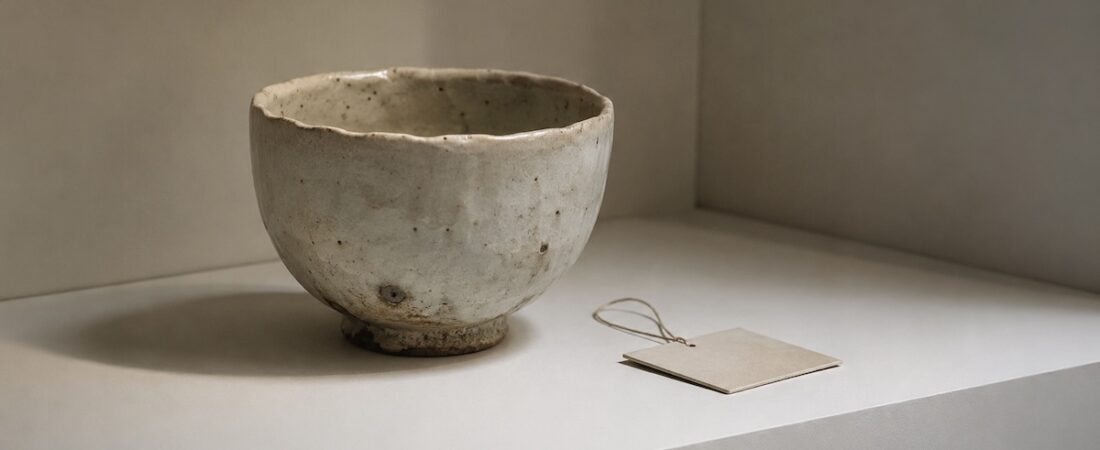
In overseas design and lifestyle contexts, it often becomes a visual style: cracked ceramics, uneven textures, natural materials, muted colours, imperfect objects photographed in soft light.
I understand the appeal. There is something real being pointed at.
At the same time, I would be careful about defining wabi-sabi too confidently. It is a deep aesthetic world, and I am not a specialist in it.
But as a Japanese speaker, my understanding is that wabi-sabi is not simply a look. It feels less like a label you put on an object, and more like a sensitivity in the person looking at it.
In Japanese, people sometimes say things like, “You’ve started to understand wabi-sabi.” That phrase makes sense to me.
When you are young, it is natural to be drawn to more obvious forms of beauty: newness, brightness, polish, impact. Much of the world still feels new. It is easy to assume that things will continue as they are.
Wabi-sabi is quieter than that. It may be something people notice more easily after they have lived a little, seen more things change, and felt for themselves that things do not last forever.
To me, it is closer to the feeling that appears when you notice beauty in impermanence, age, restraint, or a kind of sadness.
In that sense, a cracked ceramic bowl is not automatically wabi-sabi. It may invite that feeling. But the feeling itself does not come included with the product.
That is much harder to sell than a linen throw and a chipped bowl.
But the Editing Is Impressive
I want to be clear about this. I do not think this is simply a story of foreigners getting Japan wrong.
Some Japanese words do not fit neatly into English. Ikigai and wabi-sabi are good examples. The world found the parts that could travel.
Ikigai became a diagram. Wabi-sabi became an interior style.
Something hard to explain became something people could hold, post, buy, or build a conversation around.
That is not nothing. That is skill.
The result is not always precise. But it is effective. And effectiveness has value.
Many people probably found something useful through these simplified versions. Some may have started with the diagram or the design trend and then looked deeper.
That is a good thing.
What Japan Can Learn From This
What stays with me is not that these words are used differently overseas. Words travel. Meanings shift. That is normal.
What stays with me is that the world is very good at turning Japanese sensibility into something people can understand, use, and buy.
Honestly, that is impressive.
And honestly, as a Japanese person, it is a little frustrating.
Maybe part of the problem is that these words are too familiar to Japanese people to feel like assets. They are part of everyday life, so we do not always think to explain them, translate them, or package them for someone outside Japan.
This is not completely separate from Japan’s unwritten rules. In Japan, many important things are not explained because people assume everyone already understands them. The same may be true of cultural words like ikigai and wabi-sabi.
So someone outside Japan sometimes sees the value first, and packages it first.
That is the part Japan can learn from.
Not by making these words simpler just to sell them. But by making them clear enough to travel without losing too much of what made them worth translating in the first place.
Accuracy matters. But accuracy alone does not travel very far.
A good idea still needs a form people can understand.
Which Is Why I Write This
JAPAN, honestly exists because I believe Japan does not need blind praise. Japan does not need cheap criticism either.
What Japan needs, and what I am trying in my small way to contribute to, is honest translation.
Not translation that freezes Japanese words in place. Not translation that scolds the world for using them differently.
But translation that is accurate enough to be fair, clear enough to travel, and useful enough to matter.
The world is very good at turning Japanese ideas into products. That is impressive.
And honestly, as a Japanese person, it is a little frustrating.
As a Japanese person writing in English about Japan, I guess I should learn from that too — and do my part.
All of the above is one Japanese person’s interpretation. Treat it accordingly.



Leave a Reply