Stop Over-Explaining Japan: “Itadakimasu” Is Just What You Say
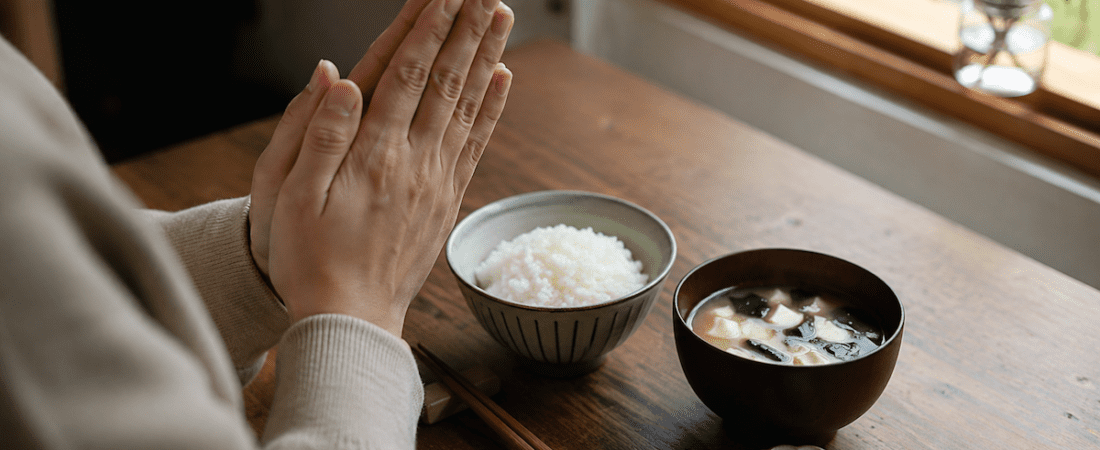
There is a particular kind of content that flourishes on the internet about Japan. It goes something like this: “Before eating, Japanese people press their hands together and say ‘itadakimasu.’ This beautiful word carries centuries of meaning — gratitude for the ingredients, respect for the farmers, reverence for the lives of the animals and plants that gave themselves so that you may eat…”
It sounds profound. It is also, for most Japanese people, not really how it works.
Ask a Japanese person why they say itadakimasu before eating, and the most honest answer is probably this: because that’s what you say. You were taught it as a child. Everyone around you says it. So you say it.
The meaning is real. The consciousness isn’t.
The Most Over-Analyzed Phrase in the Japanese Language.
The word does come from a humble form of “to receive.” The etymology is real. But etymology and lived experience are different things. When a Japanese person says itadakimasu before lunch, they are not pausing to contemplate the interconnected web of life that produced their meal. They are doing what people do before eating in Japan. That’s it.
The same is true of otsukaresama desu. Recently, I read a thoughtful, well-written essay that described this phrase as carrying deep social meaning: an acknowledgment of effort, a recognition of fatigue, a small act of human compassion in a demanding society. The analysis was not wrong. But it described something that most Japanese people have never consciously thought about. You say otsukaresama because that’s what you say when a colleague finishes work, or when someone returns from a meeting, or when the day ends. It became the thing to say, and so you say it.
Don’t believe me? Try this: ask a Japanese person if they know the deeper meaning of otsukaresama. And if — by some miracle — you happen to find that unicorn who actually does know, ask them one more question: whether they are consciously thinking about that meaning every single time they say it.
The Phrase That Breaks Every Translator.
Then there is yoroshiku onegaishimasu — a phrase that causes genuine distress among people learning Japanese. Translators have thrown up their hands trying to render it in English: “please take care of me,” “I look forward to working with you,” “regards,” “please,” “thank you in advance.” All of these translations capture something. None of them capture everything.
The reason is not that the phrase contains some untranslatable philosophical depth. The reason is simpler: it is used in so many different situations that it has become a kind of social punctuation. You say it when you meet someone. You say it at the end of emails. You say it when you ask for a favor. You say it when a meeting is about to start.
And that’s precisely the point. These phrases work because they carry no personal weight. Nobody has to decide how they feel in this moment, or how to express it, or whether the expression is appropriate. The phrase handles that. It removes the individual’s emotion from the equation entirely and replaces it with something everyone recognizes and accepts. Not philosophy. Social WD-40. A cognitive shortcut that keeps the interaction moving without anyone having to think.
Japanese people do not think carefully about which meaning of yoroshiku applies. They recognize the situation and say the appropriate thing.
And Then There’s Gochisousama.
Gochisousama, said after meals, gets similar treatment. The kanji involve characters meaning “to run,” and enthusiastic explainers will tell you it originally expressed gratitude to those who traveled great distances to gather food for a feast. Historically, perhaps. In practice, it is what you say when you finish eating.
This Isn’t a Japan Problem. It’s a Human One.
This pattern — of outsiders finding layers of meaning in phrases that insiders use on autopilot — is not unique to Japanese.
When someone says “goodbye,” nobody is wishing the other person God’s protection. The phrase meant that once — it descends from “God be with ye.” Now it means leaving. The origin is beside the point.
English does the same with “How are you?” — a genuine inquiry about health and wellbeing that became a greeting so automatic nobody expects an honest answer. You say it in a hallway. The other person says “fine.” Nobody’s health was involved.
Language lives in use, not in etymology.
The mistake is not explaining the meaning. The mistake is assuming the speaker is experiencing that meaning every time.
Phrases Accumulate History. Speakers Don’t Carry It.
When a Japanese child learns to press their hands together and say itadakimasu before dinner, they are learning a social habit, not a philosophy. When a salaryman says otsukaresama to a departing colleague, he is not composing a small poem about shared human effort. He is saying goodbye in the way that people say goodbye in that context.
None of this makes these phrases less interesting. The fact that a language has built specific rituals around meals, around work, around leaving and returning — that is worth noticing. But there is a difference between noticing what a phrase does and inventing a depth of feeling that most speakers would find surprising.
Japan is a country that gets over-explained. Some of that over-explanation is affectionate. Some of it is sincere. But when every common phrase becomes evidence of a uniquely profound national soul, something gets lost — including the actual experience of Japanese people, who are mostly just talking to each other.
Itadakimasu. Let’s eat.
All of the above is one Japanese person’s interpretation. Treat it accordingly.


Leave a Reply