
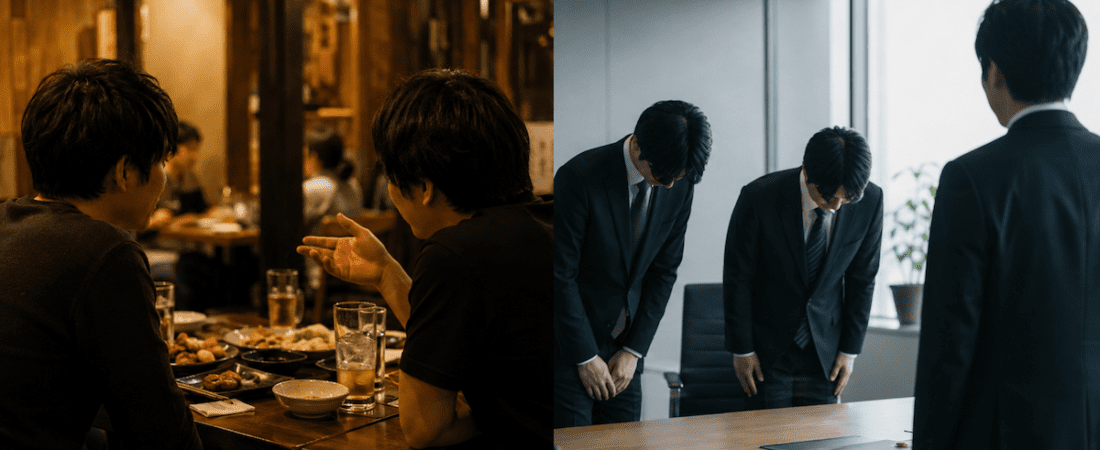
Your Japanese Is Correct. It Still Feels Wrong. – Part 1
You studied Japanese. You learned hiragana, katakana, some kanji. You memorized the verb conjugations. You practiced until you could hold a conversation.
Then you came to Japan, used it with a new friend, and something was slightly off. They smiled politely. But something in the room shifted.
What happened?
You were probably speaking the right language. Just the wrong version of it.
Japanese Isn’t One Language. It’s Several.
Most learners study what textbooks call “polite form” — the desu/masu style. It’s correct. It’s functional. And it will get you through most situations without causing offense.
But native speakers don’t actually use one fixed register. They shift constantly, often mid-conversation, based on who they’re talking to, what the relationship is, and how that relationship is evolving in real time.
Here’s a rough map of the layers.
Casual speech — tameguchi (タメ口)
This is how Japanese people talk to close friends, family, and peers of the same age. Sentence endings are short and dropped. Verbs are in plain form. It sounds relaxed, direct, and intimate.
The problem: it also sounds presumptuous if you use it with the wrong person. A stranger, a colleague you’ve just met, someone older — tameguchi with these people reads as either ignorant or rude. Sometimes both.
Textbooks often don’t teach this in a way that prepares you for real social risk, which means many learners walk around speaking to everyone like they’re a close friend. The Japanese person on the receiving end will usually say nothing. But they’ll notice.
Polite form — teineigo (丁寧語)
The desu/masu register. This is what most learners study first and use most. It’s appropriate for strangers, new acquaintances, colleagues, and most professional situations.
It’s also what most foreign speakers end up defaulting to, which is fine. It’s safe. It doesn’t presume intimacy. It doesn’t sound aggressive.
Honorific speech — keigo (敬語)
This is where things get more complex. Keigo is used with superiors, clients, customers, and anyone in a position of social authority. It involves different verb forms, different vocabulary, and sometimes different sentence structures entirely.
There are two main subcategories that confuse learners: sonkeigo (尊敬語), which elevates the other person’s actions, and kenjōgo (謙譲語), which lowers your own. Getting these mixed up — using the wrong form, applying them to the wrong person — creates an odd impression.
I’ll be honest: I’m not a linguist, and the fine distinctions between these forms aren’t what this article is about. What matters practically is something simpler, and I’ll get to that.
The Middle Ground Nobody Teaches You
Between tameguchi and full keigo, there’s a zone that native speakers navigate instinctively but that almost no textbook covers.
It’s the language of a relationship that’s warming up but hasn’t fully relaxed. Two colleagues who’ve worked together long enough to like each other, but haven’t explicitly crossed into friendship. The desu/masu endings are still there, but something has softened. Jokes are starting to appear. The formality is present but porous.
Japanese people read this zone constantly. They notice when someone shifts into it. They use it deliberately to signal that a relationship is progressing.
For a foreign learner, this middle ground is nearly invisible. The words look the same. Only the tone, the pacing, the small choices of expression tell you something has changed.
And then there’s keigo used to maintain distance.
This one surprises people. Keigo is supposed to be polite — respectful, even deferential. But in the hands of a native speaker, hyper-formal language can also be a wall. If someone is speaking to you in extremely stiff, textbook-perfect keigo, they may not be being especially respectful. They may be keeping you at arm’s length. The formality itself is the signal: we are not close, and I am not inviting closeness.
This particular usage is largely Japanese-to-Japanese. It relies on shared cultural context to land correctly. For foreign speakers, trying to deploy keigo-as-distance is almost certainly going to be misread. Don’t worry about it.
The Switch Nobody Announces
One of the most disorienting things about Japanese social language is this: the transition from keigo to casual speech is never announced.
In English, you might say “hey, you can drop the formality” or “just call me by my first name.” The shift is made explicit. Both people know it happened.
In Japanese, it just happens. Over time, gradually, the endings get shorter. The tone loosens. One day you realize you’ve been speaking tameguchi with someone for months and neither of you ever discussed it.
Foreign speakers who miss this transition — who keep using polite form long after the relationship has shifted — can seem strangely distant. Not rude, exactly. But somehow still holding everyone at a remove.
And foreign speakers who jump to tameguchi before the relationship warrants it come across as either charmingly oblivious or vaguely presumptuous, depending on the person and the context.
There is, however, a notable exception — and it says something interesting about how Japanese society processes foreign speakers.
Bobby Ologun, a Nigerian-born TV personality who became famous in Japan in the 2000s, built much of his persona around broken tameguchi — casual, sometimes crude, delivered with complete confidence. And it worked. People laughed.
But here’s the part that matters: my read is that Bobby knew exactly what he was doing. The broken Japanese, the strong language — these weren’t accidents. He understood the space that “foreigner” creates in Japanese social dynamics and used it deliberately. And off-camera, by most accounts, he was a different person entirely — someone who could navigate formal business situations with the kind of precise, careful language that takes years to internalize. He knew the rules. He just chose to play outside them on television. That’s a different thing entirely from not knowing the rules at all.
Foreign talent like Bobby occupy a particular comedic position in Japan. The same words from a Japanese person would not land the same way. The humor works precisely because of the gap between expectation and reality, and because the transgression comes from someone positioned outside the normal system. Bobby didn’t just exploit that gap. He mastered it.
New Words, Every Year
One more layer worth mentioning: Japanese slang moves fast.
New expressions emerge constantly — from social media, from variety shows, from younger generations creating their own coded language. But this isn’t random. Young people generating new slang are, in part, doing what language always does under pressure: finding new ways to signal distance and closeness outside the official system. The existing keigo structure is heavy. Slang is lighter. It creates a space where the old rules don’t fully apply — a new register invented by and for the people using it.
For a foreign learner, keeping up with this is almost impossible unless you’re living inside Japanese media and social networks in real time. And even then, using slang as a non-native speaker carries risk — it can land as natural and charming, or it can land as someone trying too hard to fit in.
So What Should You Actually Learn?
Here’s my honest, non-expert answer.
Don’t worry about sonkeigo vs. kenjōgo. Don’t try to master the nuances of keigo-as-distance. Don’t chase slang.
Learn the desu/masu register well. Use it with everyone, at least to start.
Here’s why: polite form is the safest possible default in Japanese. It doesn’t assume too much. It doesn’t come across as rude. And — this is the part people don’t expect — even when it’s wrong, it almost never causes offense.
You can use desu/masu with a close friend and they’ll just smile at the slight formality. You can use it with a senior executive and it’s perfectly appropriate. You can use it when you’re frustrated or even angry, and it functions as a buffer — the emotional content comes through, but the sharpness is cushioned.
This applies to Japanese people too, by the way. The instinct to shift into casual speech with someone younger or of lower status isn’t always the right move. A senior colleague who speaks casually to everyone below them can come across as condescending. Keigo, or at least polite form, often signals more respect — not less.
The register system in Japanese is sophisticated and takes years to fully internalize. But the entry point is simple: desu/masu, used consistently, will get you further than you think.
Part 2: Why Speaking Japanese Too Well Can Make People Uncomfortable.
All of the above is one Japanese person’s interpretation. Treat it accordingly.



Leave a Reply