

Why Japanese People Dress Up Just to Go to the Convenience Store
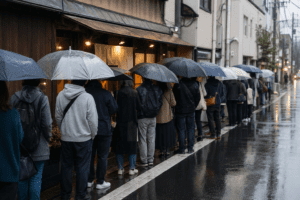
Walk into any convenience store in Japan at 11pm. You might see a woman in a full lolita dress buying onigiri. Next to her, a guy in a tracksuit. Behind him, someone in a tailored coat that probably cost more than your rent. Nobody looks twice.
That’s not a special night. That’s just Tuesday.
The freedom isn’t what you think it is.
When people say Japan has a unique fashion culture, they usually mean the wild stuff — Harajuku, cosplay, the elaborate subcultures you can photograph and post online. But that’s not what makes Japan different.
What makes Japan different is this: you don’t have to be stylish at all. And nobody will care.
In many Western places, fashion freedom means access to many kinds of “good style.” There are options — streetwear, preppy, minimalist, vintage. But underneath all of them is a shared understanding of what it means to look put-together. Deviation from that standard gets noticed. Sometimes it gets commented on.
In Japan, that standard doesn’t exist in the same way. The spectrum doesn’t run from “bad” to “good” style. It just runs.
“I want to wear this” comes before “does this look good.”
Japanese fashion — across genders, ages, subcultures — seems driven less by an external standard of attractiveness and more by personal desire. The “kawaii” phenomenon is the clearest example. Cute, in the Japanese sense, isn’t about being conventionally attractive. It’s about an aesthetic that feels good to inhabit. Frilly skirts, pastel colors, character goods — worn not to impress, but because the person wearing them genuinely wants to.
Male fashion tells a similar story in a different way. Walk around any major city and you’ll find three or four completely different tribes coexisting: the Uniqlo-and-nothing-else crowd, the Korean-influenced fitted look, the yankii aesthetic, the streetwear kids. They don’t compete. They just exist alongside each other.
But here’s the contradiction.
Japanese people are famously sensitive to standing out. The nail that sticks up gets hammered down — it’s one of the most quoted Japanese proverbs for a reason. So how does a culture that fears standing out produce this much visible individuality in what people wear?
My read: the fashion freedom exists within a very Japanese kind of balance. You can express yourself — as long as you’re expressing yourself within a recognizable frame. The lolita dress signals membership in a subculture. The yankii look has its own grammar. Even the most “out there” Japanese fashion tends to operate within a shared visual language that others can read.
What you almost never see is pure randomness that signals social confusion. The freedom is real, but it’s structured freedom.
Why does this exist here and not elsewhere?
Part of it is historical — the postwar youth culture, the influence of manga and anime on visual imagination, the suppression of individuality in school uniforms that creates a pressure valve once people leave the system.
But I think it goes deeper than that.
Japan has always had a relationship with the world that resists reduction to a single truth. Eight million gods — yaoyorozu no kami — is not just a religious concept. It’s a way of seeing. The idea that divinity, meaning, and value can exist in countless forms simultaneously. Not one god, one truth, one right way to look.
And I’d argue it wasn’t the religion that created the sensibility. It was the sensibility that made that kind of religion possible. The capacity to hold multiple coexisting truths — to let the lolita and the tracksuit guy stand in the same convenience store line without either of them being wrong — that came first.
So when you see someone in Tokyo dressed in a way that makes no sense to you, you don’t have to decode it as a message to you. They’re not making a statement. They’re just wearing what they wanted to wear today.
In Japan, that’s enough.
All of the above is one Japanese person’s interpretation. Treat it accordingly.
Leave a Reply